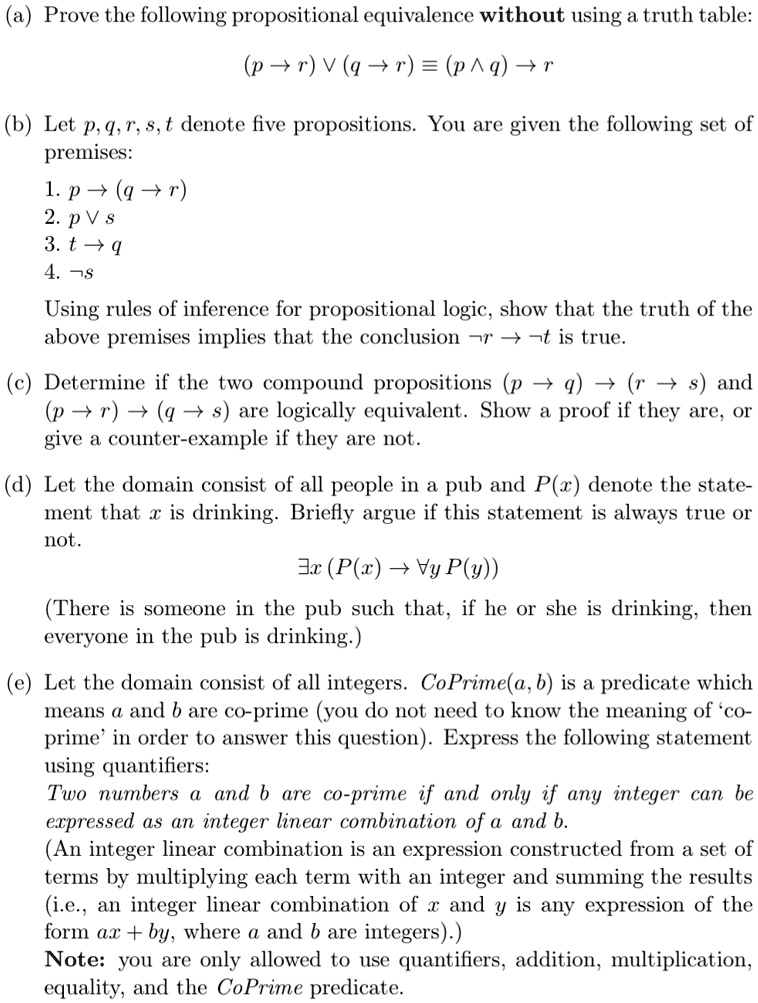
(a) Prove the following propositional equivalence without using a truth table:
(p -> r) V v(q -> r) = (p ^ (^()) q) -> r
(b) Let p, q, r, s, t denote five propositions. You are given the following set of premises:
p -> (q -> r)
p V v s
t -> q
not s
Using rules of inference for propositional logic, show that the truth of the above premises implies that the conclusion not r -> not t is true.
(c) Determine if the two compound propositions (p -> q) -> (r -> s) and (p -> r) -> (q -> s) are logically equivalent. Show a proof if they are, or give a counter-example if they are not.
(d) Let the domain consist of all people in a pub and P(x) denote the statement that x is drinking. Briefly argue if this statement is always true or not.
∃x(P(x) -> ∀yP(y))
(There is someone in the pub such that, if he or she is drinking, then everyone in the pub is drinking.)
(e) Let the domain consist of all integers. CoPrime(a, b) is a predicate which means a and b are co-prime (you do not need to know the meaning of 'coprime' in order to answer this question). Express the following statement using quantifiers:
Two numbers a and b are co-prime if and only if any integer can be expressed as an integer linear combination of a and b.
(An integer linear combination is an expression constructed from a set of terms by multiplying each term with an integer and summing the results (i.e., an integer linear combination of x and y is any expression of the form ax + by, where a and b are integers).)
(a) Prove the following propositional equivalence without using a truth table:
lF(bVd) = (uFb) ^ (uFd)
(b) Let p, q, r, s, t denote five propositions. You are given the following set of premises:
1. p -> (q -> r) 2. p V s 3. t -> q 4. s
Using rules of inference for propositional logic, show that the truth of the above premises implies that the conclusion -r - --t is true.
(c) Determine if the two compound propositions (p - q) - (r - s) and (p - r) - (q - s) are logically equivalent. Show a proof if they are, or give a counter-example if they are not.
(d) Let the domain consist of all people in a pub and P(x) denote the statement that x is drinking. Briefly argue if this statement is always true or not. ∃x(P(x) > ∀yP(y))
(There is someone in the pub such that, if he or she is drinking, then everyone in the pub is drinking.)
(e) Let the domain consist of all integers. CoPrime(a, b) is a predicate which means a and b are co-prime (you do not need to know the meaning of co-prime' in order to answer this question). Express the following statement using quantifiers: Two numbers a and b are co-prime if and only if any integer can be expressed as an integer linear combination of a and b (An integer linear combination is an expression constructed from a set of terms by multiplying each term with an integer and summing the results (i.e., an integer linear combination of x and y is any expression of the form ax + by, where a and b are integers).) Note: you are only allowed to use quantifiers, addition, multiplication, equality, and the CoPrime predicate.