Redding Manufacturing uses a job order costing system to account for its production costs.
Jobs: On January 1, 2016, there was only one job in production (Job #15-83). In January 2016, Redding started two new jobs (#16-01 and #16-02). By the end of the month, Redding had completed Jobs #15-83 and #16-01.
Overhead: Production managers calculate a predetermined overhead allocation rate based on machine hours. They use this rate to apply overhead to individual jobs. For 2016, management estimated $540,000 total overhead cost and 60,000 machine hours.
Labor costs: Redding pays direct labor employees $20.00 per hour. The monthly supervisor and staff salaries are $53,000.
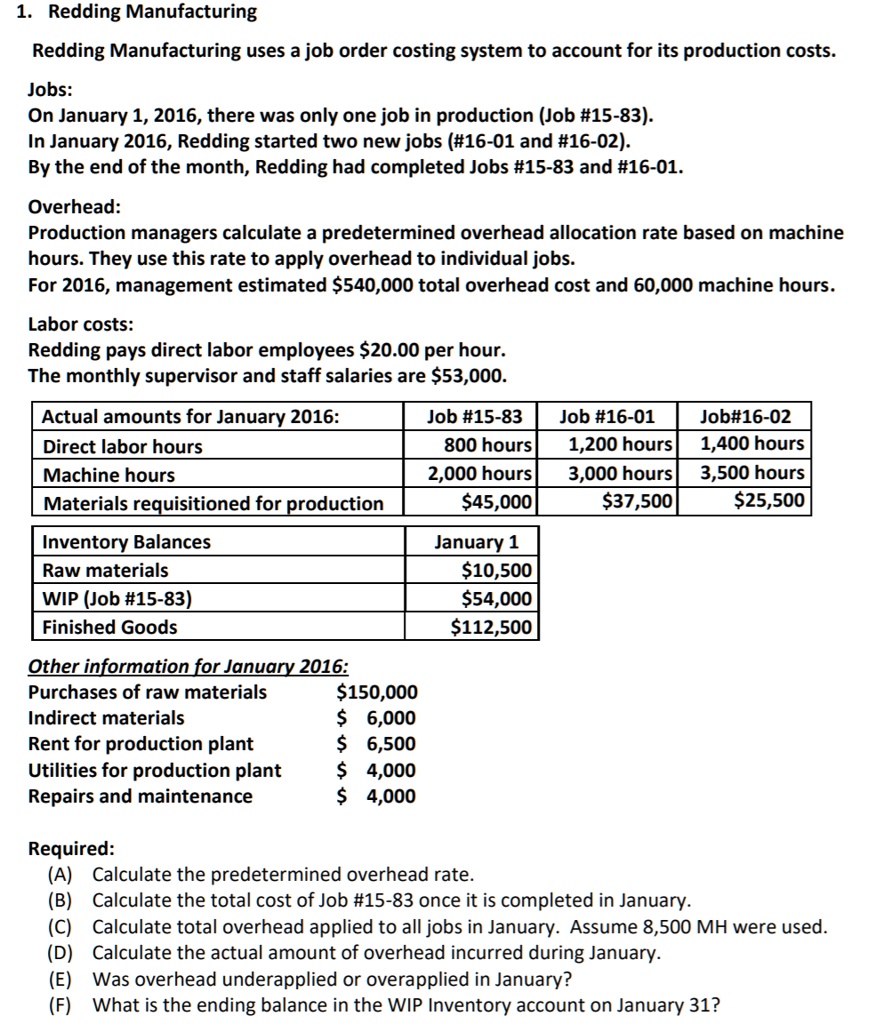
Actual amounts for January 2016:
Job #15-83: 800 hours, 2,000 machine hours, $45,000
Job #16-01: 1,200 hours, 3,000 machine hours, $37,500
Job #16-02: 1,400 hours, 3,500 machine hours, $25,500
Direct labor hours: 8,500
Machine hours: 60,000
Materials requisitioned for production:
January 1:
Raw materials: $10,500
Work in progress (Job #15-83): $54,000
Finished Goods: $112,500
Other information for January 2016:
Purchases of raw materials: $150,000
Indirect materials: $6,000
Rent for production plant: $6,500
Utilities for production plant: $4,000
Repairs and maintenance: $4,000
Required:
(A) Calculate the predetermined overhead rate.
(B) Calculate the total cost of Job #15-83 once it is completed in January.
(C) Calculate total overhead applied to all jobs in January. Assume 8,500 machine hours were used.
(D) Calculate the actual amount of overhead incurred during January.
(E) Was overhead underapplied or overapplied in January?
(F) What is the ending balance in the Work in Progress (WIP) Inventory account on January 31?