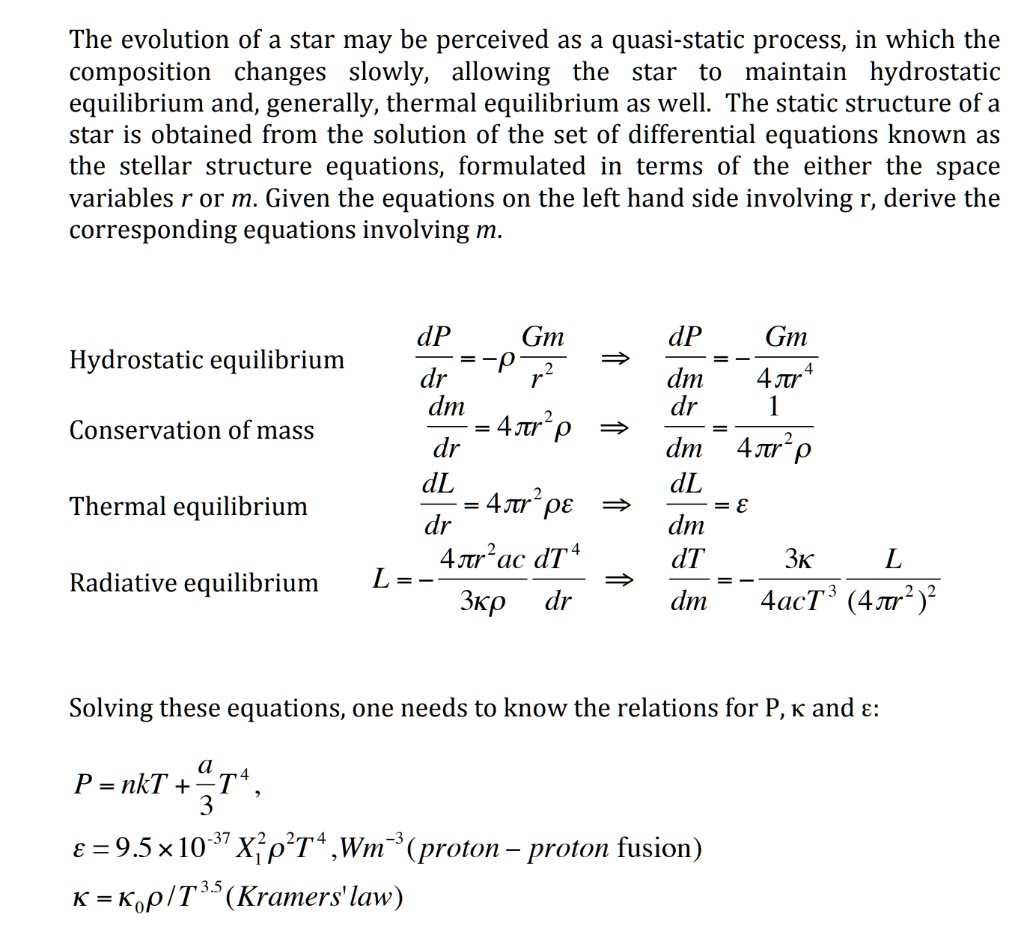
The evolution of a star may be perceived as a quasi-static process, in which the composition changes slowly, allowing the star to maintain hydrostatic equilibrium and, generally, thermal equilibrium as well. The static structure of a star is obtained from the solution of the set of differential equations known as the stellar structure equations, formulated in terms of either the space variables r or m. Given the equations on the left-hand side involving r, derive the corresponding equations involving m.
dP = Gm / dr (Hydrostatic equilibrium)
dp / dm = -1 / 4Jr^2 (Conservation of mass)
dL / dm = 3KL / 4acT^3 (Thermal equilibrium)
dP = Gm / dm
4JTr^4 / dr = 1 / 4Jr^2 dm
dL / dm = 3KL / 4acT^3 dm
(4Tr^2)^2 = L
Solving these equations, one needs to know the relations for P, k, and e:
P = nkT
& = 9.5 x 10^-37 x 3pT^4 Wm^-3 (proton - proton fusion)
K = Ko0 / T^3.5 (Kramer's law)