DERIVATIVES PROBLEM F
Assume that on October 1, 2022 a metal refining company has one million ounces of silver
that cost $5.00 per ounce total cost) in its inventory. To protect the inventory
from a decline in silver prices, the Company hedges its position by selling 200 silver futures
contracts on the New York Mercantile Exchange (NYMEX). Each contract is for 5,000
ounces of silver at $5.55 per ounce (March 20, 2023 delivery). The futures contracts mature
in March 20, 2023, which coincides with the date for which the Company has scheduled
delivery of the silver to its Japanese customer at what is then the NYMEX spot price.
The Company designates the futures contracts as a fair-value hedge of its silver inventory
(i.e., it is hedging changes in the inventory's fair value, not changes in anticipated cash
flows from the planned sale in March).
On December 31, 2022 (the Company's fiscal year-end) the March price of silver futures
has risen from $5.55 to $5.70 per ounce. On March 20, 2023, the futures price is $5.85 per
ounce.
On December 31, 2022 and March 20, 2023, the Company determines that the fair value of
its silver inventory cumulatively increased by $160,000 and $320,000, respectively.
The selling price of the silver to the Japanese customer is $5.70 per ounce on October 1 ,
2022; it is $5.85 per ounce on December 31, 2022; it is $6.00 per ounce on March 20, 2023.
The company sells the silver to the Japanese customer on March 20, 2023.
REQUIRED: Show all entries and show the partial balance sheet and income/
comprehensive income statements for years 2022 and 2023. Note: this problem is adapted
from the PWC "A Guide to Accounting for Derivative Instruments and Hedging Activities."
DERIVATIVES PROBLEM F
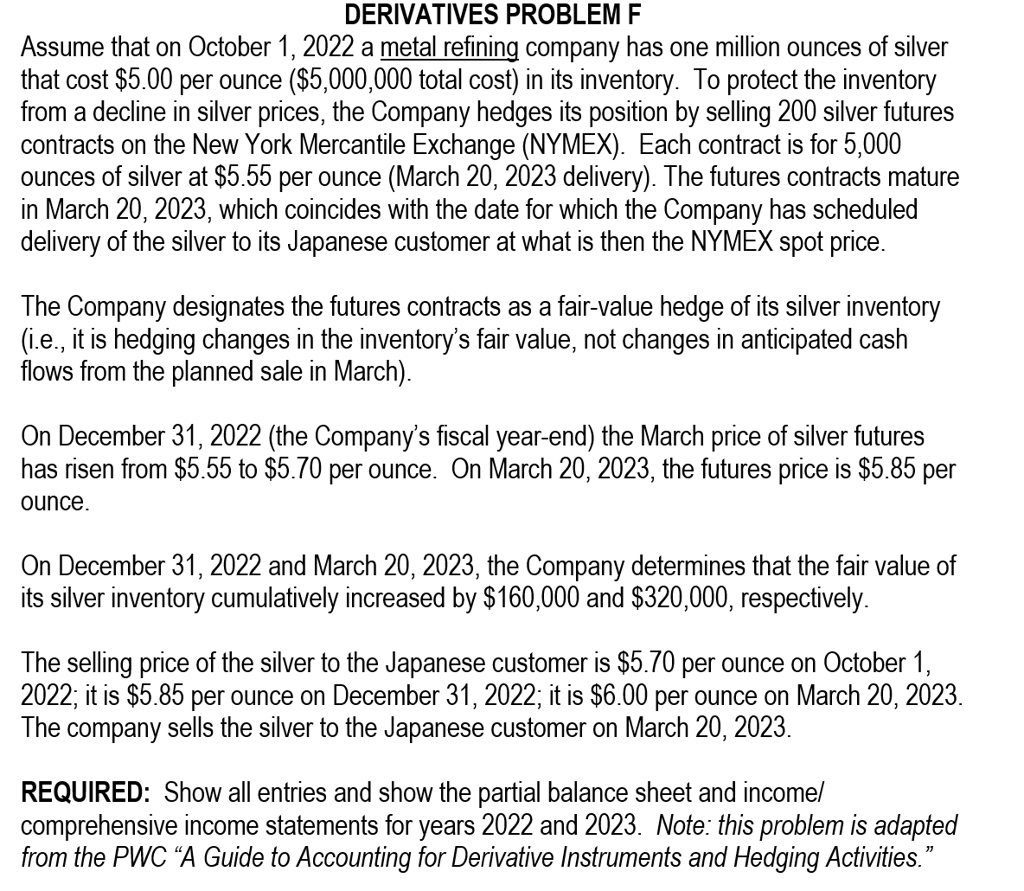
Assume that on October 1, 2022 a metal refining company has one million ounces of silver that cost $5.00 per ounce ($5,000,000 total cost) in its inventory. To protect the inventory from a decline in silver prices, the Company hedges its position by selling 200 silver futures
ounces of silver at $5.55 per ounce (March 20, 2023 delivery). The futures contracts mature in March 20, 2023, which coincides with the date for which the Company has scheduled delivery of the silver to its Japanese customer at what is then the NYMEX spot price
The Company designates the futures contracts as a fair-value hedge of its silver inventory (i.e., it is hedging changes in the inventory's fair value, not changes in anticipated cash flows from the planned sale in March).
On December 31, 2022 (the Company's fiscal year-end) the March price of silver futures
ounce.
On December 31, 2022 and March 20, 2023, the Company determines that the fair value of its silver inventory cumulatively increased by $160,000 and $320,000, respectively
The selling price of the silver to the Japanese customer is $5.70 per ounce on October 1, 2022; it is $5.85 per ounce on December 31, 2022; it is $6.00 per ounce on March 20, 2023 The company sells the silver to the Japanese customer on March 20, 2023.
REQUIRED: Show all entries and show the partial balance sheet and incomel comprehensive income statements for years 2022 and 2023. Note: this problem is adapted from the PWC "A Guide to Accounting for Derivative Instruments and Hedging Activities."