Questions asked
(3) If American auto companies make a breakthrough in automobile technology and are able to produce a car that gets 300 miles to the gallon, what will happen to the US exchange rate? A. The US dollar will appreciate B. The US dollar will depreciate C. The US dollar exchange rate will not change D. Whether the US dollar will appreciate or depreciate is uncertain
Historians Boyer and Nissenbaum cite this pattern as part of the evidence in support of an economically based interpretation of the witchcraft hysteria. See Boyer, Paul and Stephen Nissenbaum (1974). Salem Possessed: The Social Origins of Witchcraft, Cambridge: Harvard University Press.
The following statement is a summary of the process of coral bleaching. The heat damages the photosystems of coral's zooxanthellae, leading to large amounts of reactive oxygen species that are harmful to cells. Coral polyps must get rid of the damaged zooxanthellae in order to protect themselves. As more and more polyps in a colony get rid of their zooxanthellae, the colony bleaches. Corals may use cellular enzymes to destroy the damaged zooxanthellae inside their tissues. They may also expel the zooxanthellae by removing materials from cells. The damage produced by coral bleaching can have following interspecific interactions with the surrounding environment, which are a process of natural selection.
Problem 9. (5 points) Determine whether the following statements are true or false. All vectors are in $\mathbb{R}^n$. 1. Every orthogonal set in $\mathbb{R}^n$ is a linearly independent set. 2. If a set $S = \{u_1, \dots, u_p\}$ has the property that $(u_i, u_j) = 0$ whenever $i \neq j$, then $S$ is an orthonormal set. 3. A square matrix with orthonormal columns is invertible. 4. If $Q$ is an $m \times n$ matrix with orthonormal columns, then $Q^TQ = I_n$, the $n \times n$ identity matrix. Note: You can earn partial credit on this problem.
What is the value of the simple option to expand in Section 16-10 if the capacity of the plant is exceeded? Recall that this would be discovered in one year and involve an outlay of $500 million then, with cash inflows of $150 million per year for the following 19 years. The risk-free interest rate is 2% per year. Use Table 17-1, and follow Timothy Luehrman's advice for establishing a value of o. TABLE 17-1 Option Values Multiply the percentage in the table by the share price to get the approximate value of the call option. NPV = Share price + PV of exercise price 10 0.5 0.6 0.7 0.8 0.9 1.1 1.2 1.3 1.4 1.5 2 0.25 0.50 0.75 1.00 1.25 1.50 1.75 2.00 0% 2.60% 9.80% 19% 29% 38.80% 48% 56.50% 2% 5.10% 13.70% 23.60% 33.50% 42.90% 51.70% 59.70% 1% 2.80% 8.20% 12% 17.80% 21.80% 27.70% 31.60% 37.40% 40.90% 46.50% 49.60% 54.80% 57.50% 62.40% 64.60% 5.90% 15.70% 25.60% 35% 44.60% 52.30% 60.20% 69.99% 10% 19.70% 29.20% 38.30% 46.80% 54.70% 61.80% 68.30% 14.70% 23.70% 32.70% 41.20% 49.30% 56.80% 63.60% 68.69% 20% 27.60% 35.90% 44% 51.60% 58.80% 65.30% 71.10% 24.70% 31.30% 39% 46.50% 53.70% 29.40% 34.80% 41.70% 48.80% 55.70% 62.10% 68% 73.40% 33.80% 38% 44.30% 50.90% 57.40% 69.20% 74.40% 50% 51.30% 55% 59.50% 64.50% 69.40% 74% 78.30% 60.50% 66.70% 72.30%
400 ?F 250 V 240 ?F Given: In the circuit shown above, the voltage source has been elevated from zero volts up to its final value of 250 V while connected to the initially discharged series-connected capacitors. Required: Determine the amount of stored energy in the 240 µF capacitor at the end of this process. Solution: W = mJ.
509 mL of 0.490 M HCl is mixed with 226 mL of 0.280 M NaOH. What is the pH?
- What is a relation? Please provide examples. - What is a function? How is a function different from a relation? Please provide examples. - What are some of the properties of relations? Can you provide examples of relations satisfying those properties? - What are some of the properties of functions? Can you provide examples of functions satisfying those properties? Note: you can consult Appendix A in its section A.4 for a discussion on relations and functions.
what do you think is the importance of ac and dc machines in the industry today?
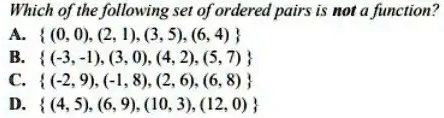
Which of the following set of ordered pairs is not a function? A. \{(0,0), (2, 1), (3, 5), (6, 4)\} B. \{(-3,-1), (3, 0), (4, 2), (5, 7) \} C. \{(-2, 9), (-1, 8), (2, 6), (6, 8) \} D. \{ (4, 5), (6, 9), (10, 3), (12, 0) \}