Ace - AI Tutor
Ask Our Educators
Textbooks
My Library
Flashcards
Scribe - AI Notes
Notes & Exams
Download App
christina morgan

christina m.

Divider

Questions asked

BEST MATCH

S1.3 Consider the $n = 3$ state of the infinite potential well, where $\Psi_3 = A \sin(2\pi x/L)e^{-j(E_3/\hbar)t}$ for $0 \le x \le L$. a. Sketch the time-independent part of the wave function $\psi_3(x)$. b. Find the average value of the position $x$. c. Sketch $\psi^*\psi$. What is the most probable location for the electron? Explain how you drew your conclusion.

View Answer
divider
BEST MATCH

A carnival game charges $3 to play. If the person wins, the carnival provides a prize worth $10. If the person loses, the carnival pays nothing. The carnival estimates that a person only has a 0.12 probability of winning. Use the probability distribution to find the

View Answer
divider
BEST MATCH

6) Morty drags Rick's unconscious body 50 meters along a flat surface. Morty applies a force of 30N at an angle of 40° above the horizontal. Find the work done by the force exerted by Morty.

View Answer
divider
BEST MATCH

A small group of first-graders is in the partial alphabetic phase of word-reading development. Which of the following fluency activities would be most appropriate for promoting these students' automaticity?

View Answer
divider
BEST MATCH

Which of the following is/are true regarding mollusc larval stages? Question 8 options: Glochidia are free-swimming larvae that filter-feed using a ciliated velum. Larval stages are not needed for mollusc dispersal. The veliger is a highly developed larval stage that functions in locomotion and filter feeding. The larval stage, known as the veliger, is followed by the trochophore larval stage.

View Answer
divider
BEST MATCH

Evaluate the indefinite integral \(\int x^5 \sin(x^6) dx = \boxed{} + C.\) \newline Hint: Use substitution.

View Answer
divider
BEST MATCH

1. Based on 13.17 Mr. Schellburger, the CEO of Schellburger Oil, is facing a dilemma--He is not sure whether or not he should drill an oil well. His decision situation is captured by the following decision tree (all prospects are expressed in millions of dollars): 0.2 Oil is Present 30 Drill 0.8 Dry Well -10 Do Not Drill 0 a. Assume Mr. Schellburger is risk neutral. Without any additional information, what will he choose? What is the value of his decision? b. Fortunately, Mr. Schellburger has access to a detector which can give him some further information on whether or not the site contains oil. The detector is symmetric and has accuracy 0.6. Write out the Assessed Form probability tree. Be sure to include all labels and probabilities. c. Write out the Inferential Form probability tree. Be sure to include all labels and probabilities. 2. True/False and Why. Indicate whether each statement is true or false and give a convincing argument for your answer. A C E B D Value a. B and C are irrelevant given &. b. Uncertainty A and Uncertainty C have both been observed when Decision D is made. c. Decision E is known before Decision D is made d. The arrow between nodes C and D is an influence arrow. 3. Name the types of arrows in the following diagrams and explain the meaning of each diagram. Y X D X X D D D

View Answer
divider
BEST MATCH

2. Consider the compound interest formula $A = P(1 + \frac{r}{n})^{nt}$ a. Solve the formula for P. b. Use the formula found in the previous step to calculate the initial deposit of an account that is worth $14,472.74 after earning 5.5% interest compounded monthly for 5 years. (Round to the nearest dollar.) c. How much more would this account be worth if it were earning interest for 5 more years?

View Answer
divider
BEST MATCH

#1. For the circuit below, find $v_o$, gain and input resistance using circuit laws and properties of operational amplifier, if $R = 4\Omega$, $R_1 = 2\Omega$, $R_2 = 0.1\Omega$, $I_i = 0.1\Omega$.

View Answer
divider
BEST MATCH

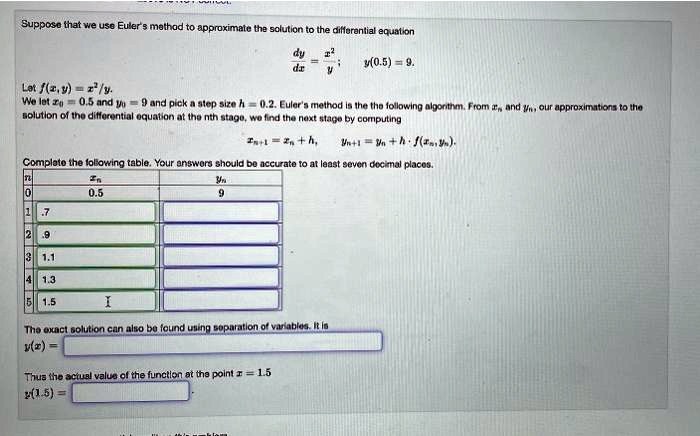
Suppose that we use Euler's method to approximate the solution to the differential equation $\frac{dy}{dx} = \frac{x^2}{y}$; $y(0.5) = 9$. Let $f(x, y) = x^2/y$. We let $x_0 = 0.5$ and $y_0 = 9$ and pick a step size $h = 0.2$. Euler's method is the the following algorithm. From $x_n$ and $y_n$, our approximations to the solution of the differential equation at the nth stage, we find the next stage by computing $x_{n+1} = x_n + h$, $y_{n+1} = y_n + hf(x_n, y_n)$. Complete the following table. Your answers should be accurate to at least seven decimal places. \begin{tabular}{|c|c|c|} \hline n & $x_n$ & $y_n$ \\ \hline 0 & 0.5 & 9 \\ 1 & 0.7 & \\\ 2 & 0.9 & \\\ 3 & 1.1 & \\\ 4 & 1.3 & \\\ 5 & 1.5 & \\\ \hline \end{tabular} The exact solution can also be found using separation of variables. It is y(x) = Thus the actual value of the function at the point $x = 1.5$ y(1.5) =
View Answer
divider