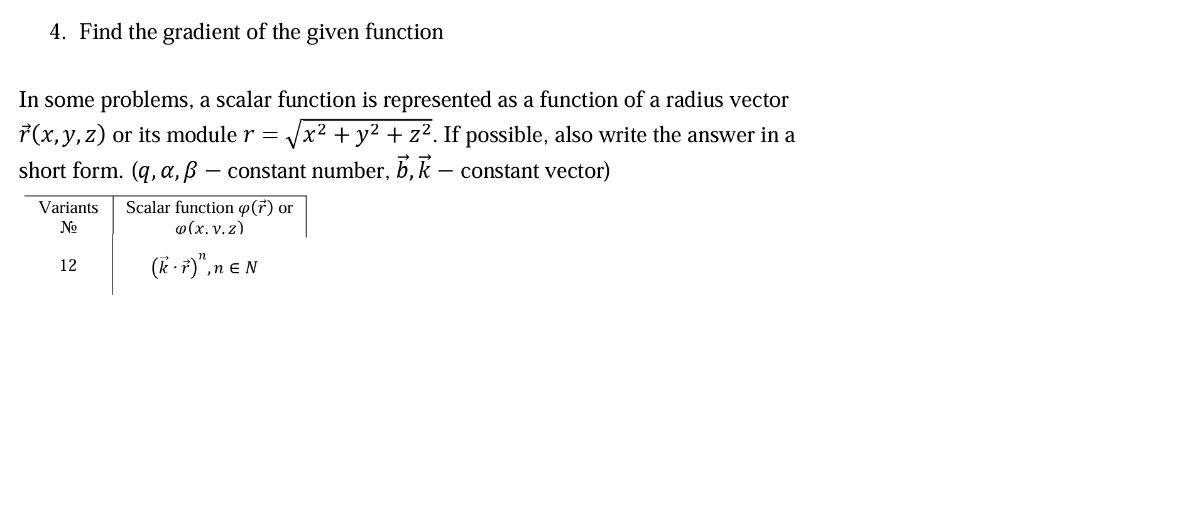
4. Find the gradient of the given function
In some problems, a scalar function is represented as a function of a radius vector \( \vec{r}(x, y, z) \) or its module \( r=\sqrt{x^{2}+y^{2}+z^{2}} \). If possible, also write the answer in a short form. ( \( q, \alpha, \beta- \) constant number, \( \vec{b}, \vec{k} \) - constant vector)
\begin{tabular}{c|c|}
\hline \begin{tabular}{c}
Variants \\
?
\end{tabular} & \begin{tabular}{c}
Scalar function \( \varphi(\vec{r}) \) or \\
\( \varphi(x, v, z) \)
\end{tabular} \\
12 & \( (\vec{k} \cdot \vec{r})^{n}, n \in N \)
\end{tabular}