1. Name two factors which impact how fast a reaction occurs: (a) concentration and time (b) temperature and time (c) temperature and concentration (d) rate and time
2. As time passes, the rate of a reaction (a) decreases (b) increases (c) remains constant (d) may increase or decrease depending on the measurement technique
3. The energy barrier which reactants must cross to turn into products is called the: (a) frequency factor (b) the Arrhenius barrier (c) the rate wall (d) the energy of activation
4. In a rate law, K is: (a) the rate constant (b) the frequency factor (c) the activation energy (d) the equilibrium constant (e) K does not appear in a rate law
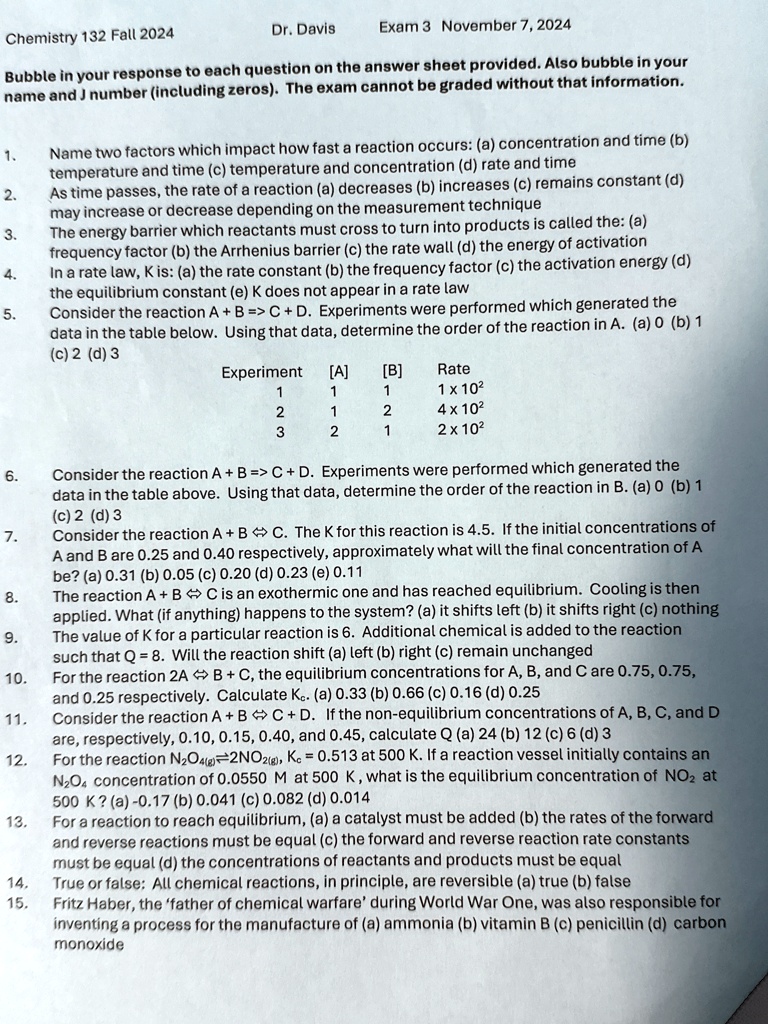
5. Consider the reaction $A + B \implies C + D$. Experiments were performed which generated the data in the table below. Using that data, determine the order of the reaction in A. (a) 0 (b) 1 (c) 2 (d) 3
Experiment [A] [B] Rate
1 1 1 $1 \times 10^2$
2 1 2 $4 \times 10^2$
3 2 1 $2 \times 10^2$
6. Consider the reaction $A + B \implies C + D$. Experiments were performed which generated the data in the table above. Using that data, determine the order of the reaction in B. (a) 0 (b) 1 (c) 2 (d) 3
7. Consider the reaction $A + B \implies C$. The K for this reaction is 4.5. If the initial concentrations of A and B are 0.25 and 0.40 respectively, approximately what will the final concentration of A be? (a) 0.31 (b) 0.05 (c) 0.20 (d) 0.23 (e) 0.11
8. The reaction $A + B \implies C$ is an exothermic one and has reached equilibrium. Cooling is then applied. What (if anything) happens to the system? (a) it shifts left (b) it shifts right (c) nothing
9. The value of K for a particular reaction is 6. Additional chemical is added to the reaction such that Q = 8. Will the reaction shift (a) left (b) right (c) remain unchanged
10. For the reaction $2A \implies B + C$, the equilibrium concentrations for A, B, and C are 0.75, 0.75, and 0.25 respectively. Calculate $K_c$. (a) 0.33 (b) 0.66 (c) 0.16 (d) 0.25
11. Consider the reaction $A + B \implies C + D$. If the non-equilibrium concentrations of A, B, C, and D are, respectively, 0.10, 0.15, 0.40, and 0.45, calculate Q (a) 24 (b) 12 (c) 6 (d) 3
12. For the reaction $N_2O_4(g) \implies 2NO_2(g)$, $K_c = 0.513$ at 500 K. If a reaction vessel initially contains an $N_2O_4$ concentration of 0.0550 M at 500 K, what is the equilibrium concentration of $NO_2$ at 500 K? (a) -0.17 (b) 0.041 (c) 0.082 (d) 0.014
13. For a reaction to reach equilibrium, (a) a catalyst must be added (b) the rates of the forward and reverse reactions must be equal (c) the forward and reverse reaction rate constants must be equal (d) the concentrations of reactants and products must be equal
14. True or false: All chemical reactions, in principle, are reversible (a) true (b) false
15. Fritz Haber, the 'father of chemical warfare' during World War One, was also responsible for inventing a process for the manufacture of (a) ammonia (b) vitamin B (c) penicillin (d) carbon monoxide