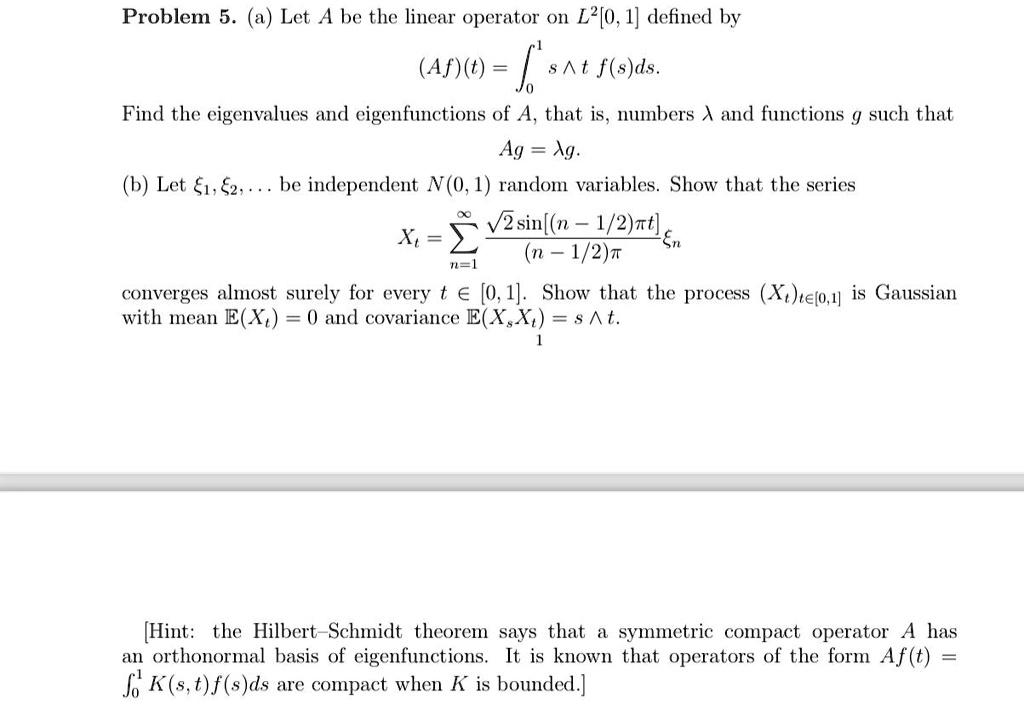
(a) Let A be the linear operator on L^(2)[0,1] defined by
(Af)(t) = int_0^1 s^(1/2)tf(s)ds
Find the eigenvalues and eigenfunctions of A, that is, numbers λ and functions g such that
Ag = λg.
(b) Let ξ_(1), ξ_(2), ... be independent N(0,1) random variables. Show that the series
x_(t) = ∑_(n=1)^(∞) (sqrt(2)sin[(n-(1/2))πt])/((n-(1/2))π)ξ_(n)
converges almost surely for every t in [0,1]. Show that the process (x_(t))_(t in [0,1]) is Gaussian with mean E(x_(t)) = 0 and covariance E(x_(s)x_(t)) = s^(1/2)t.
[Hint: the Hilbert-Schmidt theorem says that a symmetric compact operator A has an orthonormal basis of eigenfunctions. It is known that operators of the form Af(t) = ∫_0^1 K(s,t)f(s)ds are compact when K is bounded.]
Problem 5.(a) Let A be the linear operator on L2[0,1] defined by
(Af)(t) = ∫_0^1 sAtf(s)ds
Find the eigenvalues and eigenfunctions of A, that is, numbers λ and functions g such that
Ag = λg.
(b) Let 1,2,... be independent N(0,1) random variables. Show that the series
n-(1/2)T
n=1
converges almost surely for every t in [0,1]. Show that the process (Xt) in [0,1] is Gaussian with mean E(X) = 0 and covariance EXX = sAt.
Hint: the Hilbert-Schmidt theorem says that a symmetric compact operator A has an orthonormal basis of eigenfunctions. It is known that operators of the form Af(t) = ∫_0^1 K(s,t)f(s)ds are compact when K is bounded.