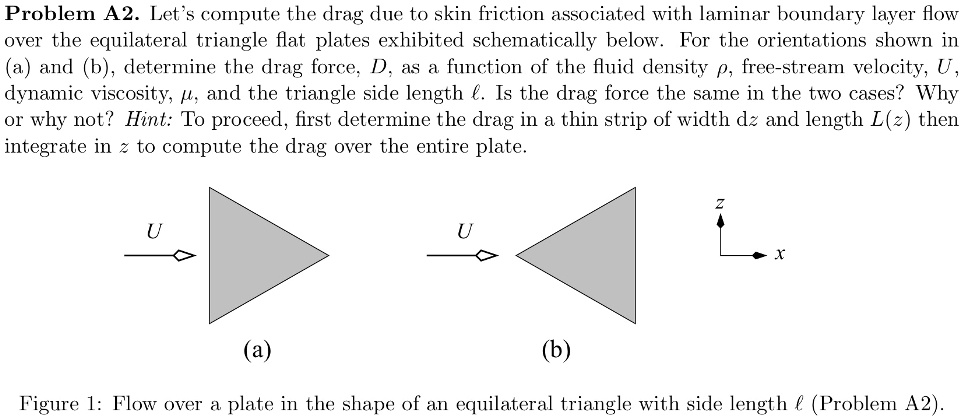
Problem A2. Let's compute the drag due to skin friction associated with laminar boundary layer flow
over the equilateral triangle flat plates exhibited schematically below. For the orientations shown in
(a) and (b), determine the drag force, $D$, as a function of the fluid density $\rho$, free-stream velocity, $U$,
dynamic viscosity, $\mu$, and the triangle side length $\ell$. Is the drag force the same in the two cases? Why
or why not? Hint: To proceed, first determine the drag in a thin strip of width $dz$ and length $L(z)$ then
integrate in $z$ to compute the drag over the entire plate.
U
(a)
U
(b)
X
Figure 1: Flow over a plate in the shape of an equilateral triangle with side length $\ell$ (Problem A2).