1 Background
The microprocessor cache has a set of flag bits. We have used only one so far, the valid bit which
indicates if a row is in use. There are other bits: ^(1)
Least recently used bit(s) (LRU). Some bits used as meta data to determine which is the
oldest block in the row. This determine which block gets evicted during a capacity miss.
Dirty bit. In multi-level caches, the dirty bit indicates if the current cache level has a modified
version of a block that is inconsistent with lower cache levels (and the virtual memory).
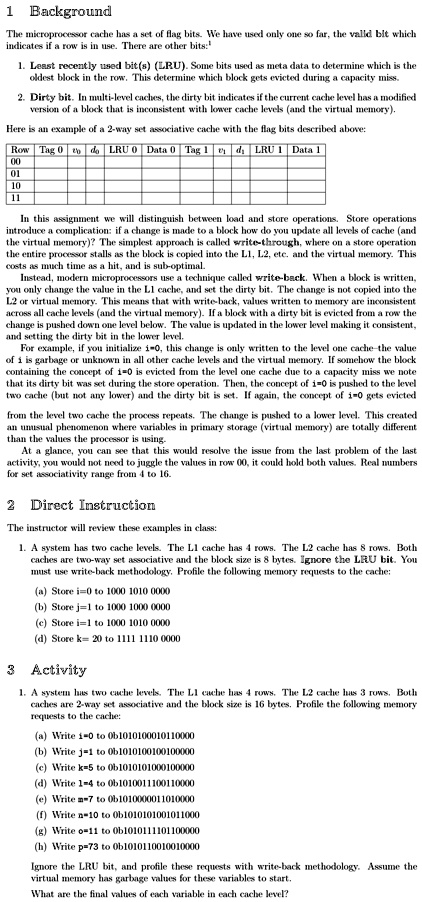
Here is an example of a 2-way set associative cache with the flag bits described above:
In this assignment we will distinguish between load and store operations. Store operations
introduce a complication: if a change is made to a block how do you update all levels of cache (and
the virtual memory)? The simplest approach is called write-through, where on a store operation
the entire processor stalls as the block is copied into the L1, L2, etc. and the virtual memory. This
costs as much time as a hit, and is sub-optimal.
Instead, modern microprocessors use a technique called write-back. When a block is written,
you only change the value in the L1 cache, and set the dirty bit. The change is not copied into the
L2 or virtual memory. This means that with write-back, values written to memory are inconsistent
across all cache levels (and the virtual memory). If a block with a dirty bit is evicted from a row the
change is pushed down one level below. The value is updated in the lower level making it consistent,
and setting the dirty bit in the lower level.
For example, if you initialize i=0, this change is only written to the level one cache-the value
of i is garbage or unknown in all other cache levels and the virtual memory. If somehow the block
containing the concept of i=0 is evicted from the level one cache due to a capacity miss we note
that its dirty bit was set during the store operation. Then, the concept of i=0 is pushed to the level
two cache (but not any lower) and the dirty bit is set. If again, the concept of i=0 gets evicted
from the level two cache the process repeats. The change is pushed to a lower level. This created
an unusual phenomenon where variables in primary storage (virtual memory) are totally different
than the values the processor is using.
At a glance, you can see that this would resolve the issue from the last problem of the last
activity, you would not need to juggle the values in row 00 , it could hold both values. Real numbers
for set associativity range from 4 to 16.
2 Direct Instruction
The instructor will review these examples in class:
A system has two cache levels. The L1 cache has 4 rows. The L2 cache has 8 rows. Both
caches are two-way set associative and the block size is 8 bytes. Ignore the LRU bit. You
must use write-back methodology. Profile the following memory requests to the cache:
(a) Store i=0 to 100010100000
(b) Store j=1 to 100010000000
(c) Store i=1 to 100010100000
(d) Store k=20 to 111111100000
3 Activity
A system has two cache levels. The L1 cache has 4 rows. The L2 cache has 3 rows. Both
caches are 2-way set associative and the block size is 16 bytes. Profile the following memory
requests to the cache:
(a) Write i=0 to 0b1010100010110000
(b) Write j=1 to 0b1010100100100000
(c) Write k=5 to 0b1010101000100000
(d) Write 1=4 to 0b1010011100110000
(e) Write m=7 to 0b1010000011010000
(f) Write n=10 to 0b1010101001011000
(g) Write o=11 to 0b1010111101100000
(h) Write p=73 to 0b1010110010010000
Ignore the LRU bit, and profile these requests with write-back methodology. Assume the
virtual memory has garbage values for these variables to start.
What are the final values of each variable in each cache level?
Background
The microprocessor cache has a set of flag bits. We have used only one so far, the valid blt which indicates if a row is in use. There are other bits:1
1. Least recently used bit(s) (LRU). Some bits used as meta data to determine which is the oldest block in the row, This determine which block gets evicted during a capacity miss.
2. Dirty bit. In multi-level caches, the dirty bit indicates if the current cache level has a modified version of a block that is inconsistent with lower cache levels (and the virtual memory). Here is an example of a 2-way set associative cache with the flag bits described above:
RowTag 0odoLRU 0Data 0|Tag 1d|LRU 1Data 1 00 10 10 11
In this assignment we will distinguish between load and store operations. Store operations introduce a complication: if a change is made to a block how do you update all levels of cache (and the virtual memory)? The simplest approach is called write-through, where on a store operation the entire processor stalls as the block is copied into the L1, L2, ete. and the virtual memory. This costs as much time as a hit, and is sub-optimal Instead, modern microprocessors use a technique called write-back. When a block is written,
L2 or virtual memory. This means that with write-back, values written to memory are inconsistent across all cache levels (and the virtual mermory). If a block with a dirty bit is evicted from a row the change is pushed down one level below. The value is updated in the lower level making it consistent, and setting the dirty bit in the lower level. For example, if you initialize i=0, this change is only written to the level one cachethe value of i is garbage or unknown in all other cache levels and the virtual memory. If somehow the block containing the concept of i=0 is evicted from the level one cache due to a capacity miss we note that its dirty bit was set during the store operation. Then, the concept of i=0 is pushed to the level two cache (but not any lower) and the dirty bit is set. If again, the concept of i=0 gets evicted
from the level two cache the process repeats. The change is pushed to a lower level. This created an unusual phenomenon where variables in primary storage (virtual memory) are totally different than the values the processor is using. At a glance, you can see that this would resolve the issue from the last problem of the last activity, you would not neod to juggle the values in row 00, it could hold both values. Real numbers for set associativity range from 4 to 16.
Direct Instruction
The instructor will review these examples in class: 1. A system has two cache levels. The L1 cache has 4 rows. The L2 cache has 8 rows. Both caches are two-way set associative and the block size is 8 bytes. Ignore the LRU bit. You must use write-back methodology. Profile the following memory requests to the cache: (a) Store i=0 to 1000 1010 0000 (b) Store j=1 to 1000 1000 0000 (c) Store i=1 to 1000 1010 0000 (d) Store k= 20 to 1111 1110 0000
3
Activity
1. A system has two cache levels. The L1 cache has 4 rows. The L2 cache has 3 rows. Both caches are 2-way set associative and the block size is 16 bytes. Profile the following memory requests to the cache: (a) Write i=0 to 0b1010100010110000 (b) Write j=1 to 0b1010100100100000 (c Write k=5 to 0b1010101000100000 (d) Write 1=4 to 0b1010011100110000 (e) Write n=7 to 0b1010000011010000 f Write n-10 to 0b1010101001011000 (g) Write o=11 to 0b1010111101100000 (h) Write p=73 to 0b1010110010010000
Ignore the LRU bit, and profile these requests with write-back methodology. Assume the virtual memory has garbage values for these variables to start. What are the final values of each variable in cach cache level?