PHYSICS 1
Section II
Time—1 hour and 30 minutes
5 Questions
Directions: Questions 1, 4, and 5 are short free-response questions that require about 13 minutes each to answer and
are worth 7 points each. Questions 2 and 3 are long free-response questions that require about 25 minutes each to
answer and are worth 12 points each. Show your work for each part in the space provided after that part.
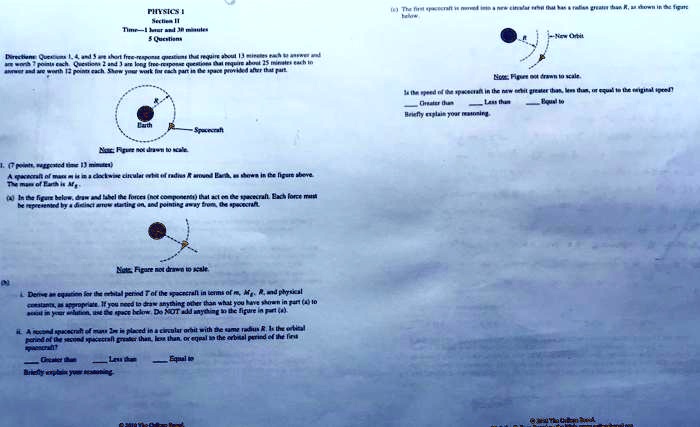
(i) The first spacecraft is moved into a new circular orbit that has a radius greater than $R$, as shown in the figure
below.
New Orbit
Note: Figure not drawn to scale.
Is the speed of the spacecraft in the new orbit greater than, less than, or equal to the original speed?
Greater than_____ Less than_____ Equal to_____
Briefly explain your reasoning.
Earth
Spacecraft
Note: Figure not drawn to scale.
1. (7 points, suggested time 13 minutes)
A spacecraft of mass $m$ is in a clockwise circular orbit of radius $R$ around Earth, as shown in the figure above.
The mass of Earth is $M_E$.
(a) In the figure below, draw and label the forces (not components) that act on the spacecraft. Each force must
be represented by a distinct arrow starting on, and pointing away from, the spacecraft.
Note: Figure not drawn to scale.
(b) i. Derive an equation for the orbital period $T$ of the spacecraft in terms of $m$, $M_E$, $R$, and physical
constants, as appropriate. If you need to draw anything other than what you have shown in part (a) to
assist in your solution, use the space below. Do NOT add anything to the figure in part (a).
ii. A second spacecraft of mass $2m$ is placed in a circular orbit with the same radius $R$. Is the orbital
period of the second spacecraft greater than, less than, or equal to the orbital period of the first
spacecraft?
Greater than_____ Less than_____ Equal to_____