Linear algebra. q 3, 4 please
a
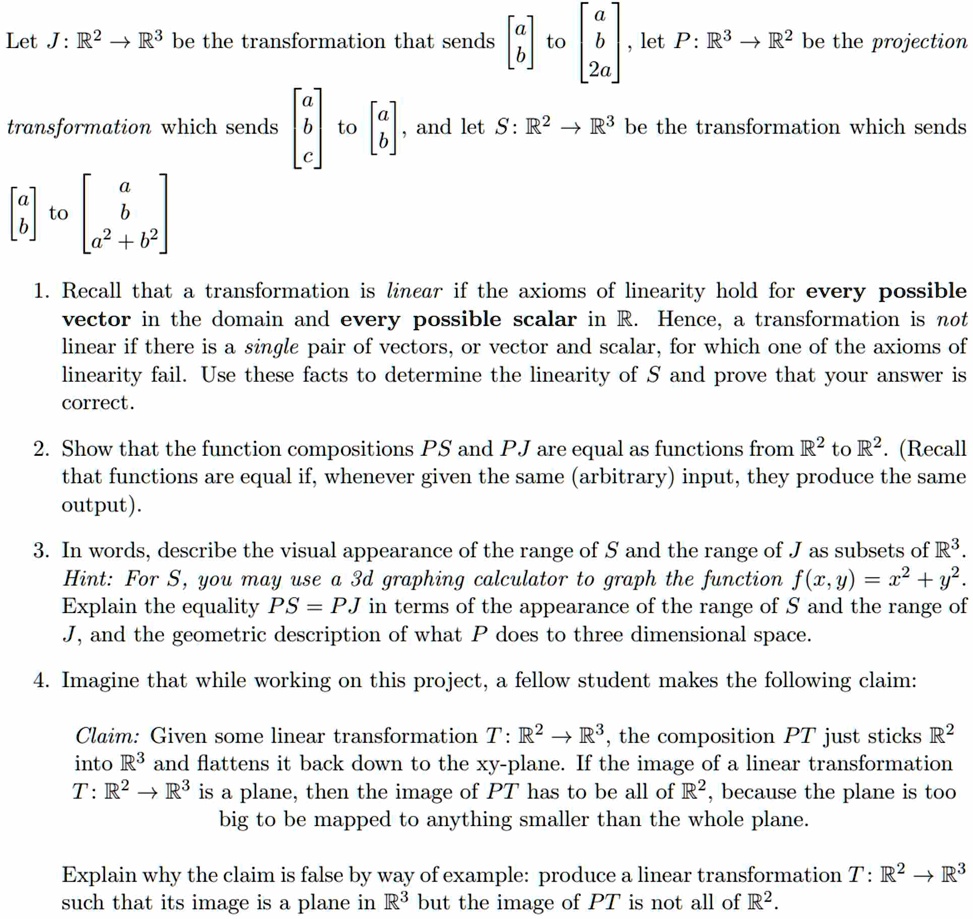
Let J: R2 - R3 be the transformation that sends h
to
b let P: R3-R2 be the projection [2a]
transformation which sends
and let S: R2 R3 be the transformation which sends
[a] [b]
a
1. Recall that a transformation is linear if the axioms of linearity hold for every possible vector in the domain and every possible scalar in R. Hence, a transformation is not linear if there is a single pair of vectors, or vector and scalar, for which one of the axioms of linearity fail. Use these facts to determine the linearity of S and prove that your answer is correct.
2. Show that the function compositions PS and PJ are equal as functions from R to R2.(Recall that functions are equal if, whenever given the same (arbitrary) input,they produce the same output).
3. In words, describe the visual appearance of the range of S and the range of J as subsets of R3 Hint: For S, you may use a 3d graphing calculator to graph the function f(x,y) = x2 + y? Explain the equality PS = PJ in terms of the appearance of the range of S and the range of J, and the geometric description of what P does to three dimensional space.
4. Imagine that while working on this project, a fellow student makes the following claim:
Claim: Given some linear transformation T : R2 R3, the composition PT just sticks R2 into R3 and flattens it back down to the xy-plane. If the image of a linear transformation T: R2 R3 is a plane, then the image of PT has to be all of R2, because the plane is too big to be mapped to anything smaller than the whole plane.
Explain why the claim is false by way of example: produce a linear transformation T : R2 > R3 such that its image is a plane in R3 but the image of PT is not all of R2.