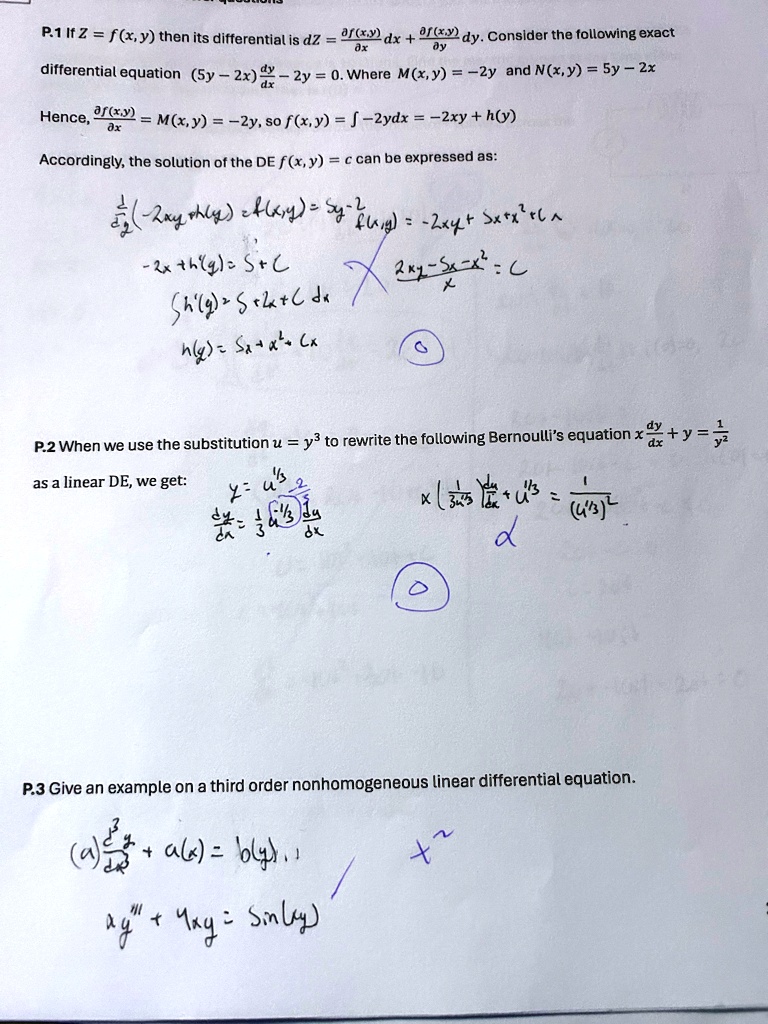
P.1 If Z = f(x, y) then its differential is dz = $$\frac{\partial f(x,y)}{\partial x}$$ dx + $$\frac{\partial f(x,y)}{\partial y}$$ dy. Consider the following exact
differential equation (5y - 2x) $$\frac{dy}{dx}$$ - 2y = 0. Where M(x, y) = -2y and N(x, y) = 5y - 2x
Hence, $$\frac{\partial f(x,y)}{\partial x}$$ = M(x, y) = -2y, so f(x, y) = ∫-2ydx = -2xy + h(y)
Accordingly, the solution of the DE f(x, y) = c can be expressed as:
$$\frac{1}{2}$$ (-2xyh(y)) + h(x,y) = 5y - 2x
-2x th(y) + S + C
h(y) = Sx + x² + Cx
P.2 When we use the substitution u = y³ to rewrite the following Bernoulli's equation x $$\frac{dy}{dx}$$ + y = $$\frac{1}{y^2}$$
as a linear DE, we get:
y = u¹/³
x $$\frac{du}{dx}$$ + 3u¹/³ = $$\frac{1}{(u¹/³)}$$
P.3 Give an example on a third order nonhomogeneous linear differential equation.
(a) $$\frac{d^3y}{dx^3}$$ + a(x) = b(y),
ay''' + 4xy' = sin(4y)