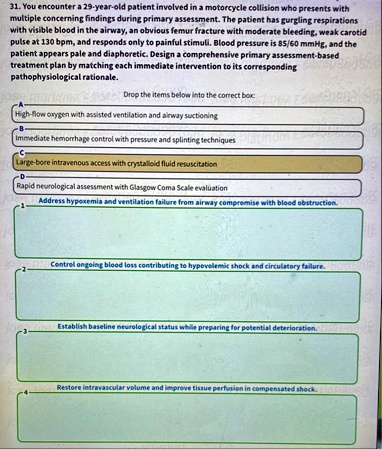
31. You encounter a 29-year-old patient involved in a motorcycle collision who presents with multiple concerning findings during primary assessment. The patient has gurgling respirations with visible blood in the airway, an obvious femur fracture with moderate bleeding, weak carotid pulse at 130 bpm, and responds only to painful stimuli. Blood pressure is 85/60 mmHg, and the patient appears pale and diaphoretic. Design a comprehensive primary assessment-based treatment plan by matching each immediate intervention to its corresponding pathophysiological rationale.
Drop the items below into the correct box:
A- High-flow oxygen with assisted ventilation and airway suctioning
B- Immediate hemorrhage control with pressure and splinting techniques
C- Large-bore intravenous access with crystalloid fluid resuscitation
D- Rapid neurological assessment with Glasgow Coma Scale evaluation
1- Address hypoxemia and ventilation failure from airway compromise with blood obstruction.
2- Control ongoing blood loss contributing to hypovolemic shock and circulatory failure.
3- Establish baseline neurological status while preparing for potential deterioration.
4- Restore intravascular volume and improve tissue perfusion in compensated shock.