Questions asked
Assume pairs of X and Y variables have the following correlations. For which correlation could you most accurately predict Y from X? 0 50 -.90 85
A part of a sequenced chromosome has the sequence (on one strand) ATTGCATCCGCGCGTGCGCGCGCGATCCCGTTACTTTCCG Enter the longest part of this sequence that is most likely to take up the Z conformation. sequence: CGCGCGCGC Incorrect Answer
QUESTION 8: What can you say about the acceleration of a projectile, as it flies through the air?
What will happen if you put the slide upside down on the stage (specimen facing down)?
A Product-Favored reaction has ... [R] > [P] at Equilibrium [R] = [P] at Equilibrium [P] > [R] at Equilibrium [R] = 0 at Equilibrium
Question Four Study figure A, which represents a specific type of bridge and answer the questions that foll Figure A What type of bridge is represented by figure \( A \) ? State three advantages of this type of bridge. How is the force distributed in this type of bride? Suppose that you want to make figure \( A \) look like figure \( B \) below: Figure B 4.4.1 What physical changes must be made to figure \( A \) ?
A financial organization is currently handling a document to contain sensitive customer information which is protected by the nondisclosure agreement according to the data classifications how should the financial organization characterize the data
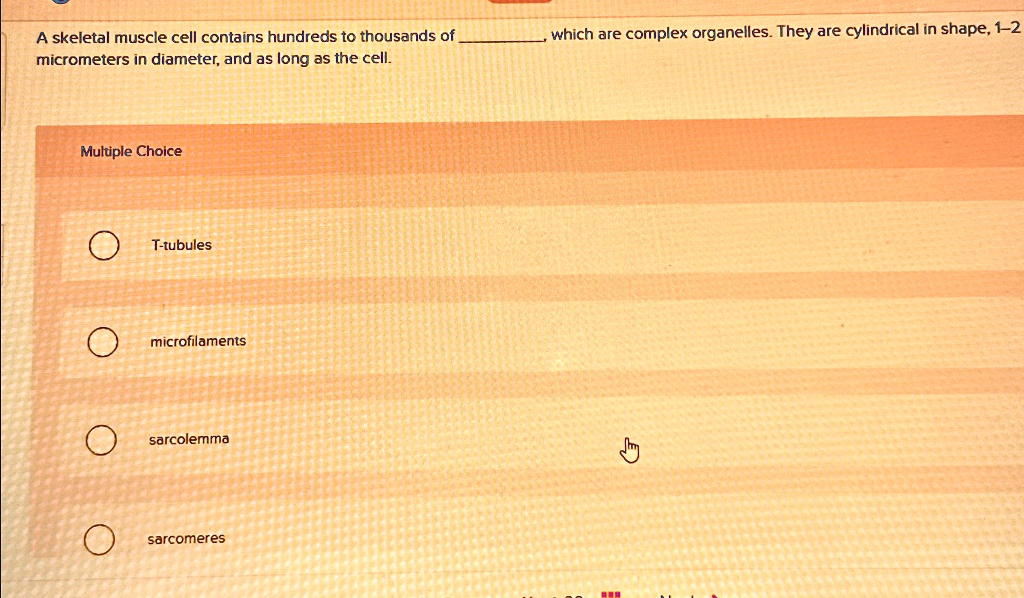
A skeletal muscle cell contains hundreds to thousands of _____, which are complex organelles. They are cylindrical in shape, 1-2 micrometers in diameter, and as long as the cell. Multiple Choice T-tubules microfilaments sarcolemma sarcomeres
Find the inverse Laplace transform of the function by using the convolution theorem. $F(s) = \frac{1}{(s+3)^3(s^2+4)}$ $\mathcal{L}^{-1}\{F(s)}(t) = $ Choose one
Which of the following statements is not correct? Group of answer choices The government may use antitrust laws to break up an existing company to improve competition. The government may break up a natural monopoly to lower the price charged to customers. Economists usually prefer private ownership to public ownership of natural monopolies. Sometimes the best strategy is for the government to do nothing about monopoly inefficiency because the "fix" may be worse than the problem.