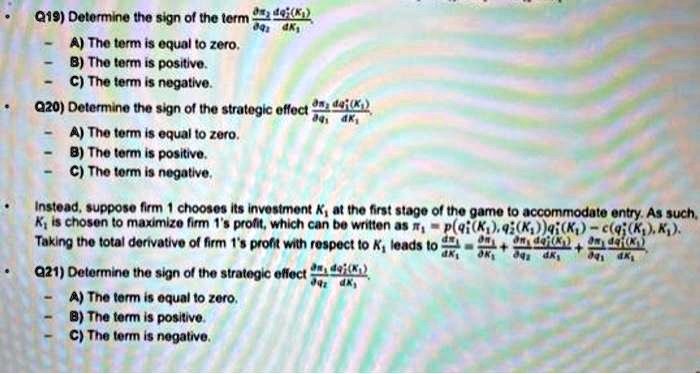
Q19) Determine the sign of the term $\frac{\partial m_1}{\partial q_1}\frac{\partial q_1(K_1)}{\partial K_1}$
A) The term is equal to zero.
B) The term is positive.
C) The term is negative.
Q20) Determine the sign of the strategic effect $\frac{\partial m_1}{\partial q_2}\frac{\partial q_2(K_1)}{\partial K_1}$
A) The term is equal to zero.
B) The term is positive.
C) The term is negative.
Instead, suppose firm 1 chooses its investment $K_1$ at the first stage of the game to accommodate entry. As such,
$K_1$ is chosen to maximize firm 1's profit, which can be written as $\pi_1 = p(q_1(K_1), q_2(K_1))q_1(K_1) - c(q_1(K_1), K_1)$.
Taking the total derivative of firm 1's profit with respect to $K_1$ leads to $\frac{d\pi_1}{dK_1} = \frac{\partial \pi_1}{\partial K_1} + \frac{\partial \pi_1}{\partial q_1}\frac{\partial q_1(K_1)}{\partial K_1} + \frac{\partial \pi_1}{\partial q_2}\frac{\partial q_2(K_1)}{\partial K_1}$
Q21) Determine the sign of the strategic effect $\frac{\partial m_1}{\partial q_2}\frac{\partial q_2(K_1)}{\partial K_1}$
A) The term is equal to zero.
B) The term is positive.
C) The term is negative.