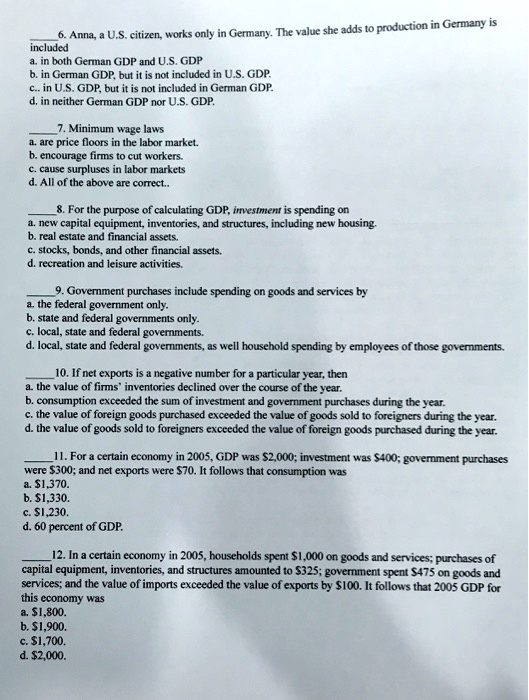
a. included in both German GDP and U.S. GDP
b. included in German GDP, but it is not included in U.S. GDP.
c. included in U.S. GDP, but it is not included in German GDP.
d. not included in neither German GDP nor U.S. GDP.
7. Minimum wage laws
a. are price floors in the labor market.
b. encourage firms to cut workers.
c. cause surpluses in labor markets.
d. All of the above are correct.
8. For the purpose of calculating GDP, investment is spending on
a. new capital equipment, inventories, and structures, including new housing.
b. real estate and financial assets.
c. stocks, bonds, and other financial assets.
d. recreation and leisure activities.
9. Government purchases include spending on goods and services by
a. the federal government only.
b. state and federal governments only.
c. local, state and federal governments.
d. local, state and federal governments, as well as household spending by employees of those governments.
10. If net exports is a negative number for a particular year, then
a. the value of firms' inventories declined over the course of the year.
b. consumption exceeded the sum of investment and government purchases during the year.
c. the value of foreign goods purchased exceeded the value of goods sold to foreigners during the year.
d. the value of goods sold to foreigners exceeded the value of foreign goods purchased during the year.
11. For a certain economy in 2005, GDP was $2,000; investment was $400; government purchases were $300; and net exports were $70. It follows that consumption was
a. $1,370.
b. $1,330.
c. $1,230.
d. 60 percent of GDP.
12. In a certain economy in 2005, households spent $1,000 on goods and services; purchases of capital equipment, inventories, and structures amounted to $325; government spent $475 on goods and services; and the value of imports exceeded the value of exports by $100. It follows that 2005 GDP for this economy was
a. $1,800.
b. $1,900.
c. $1,700.
d. $2,000.