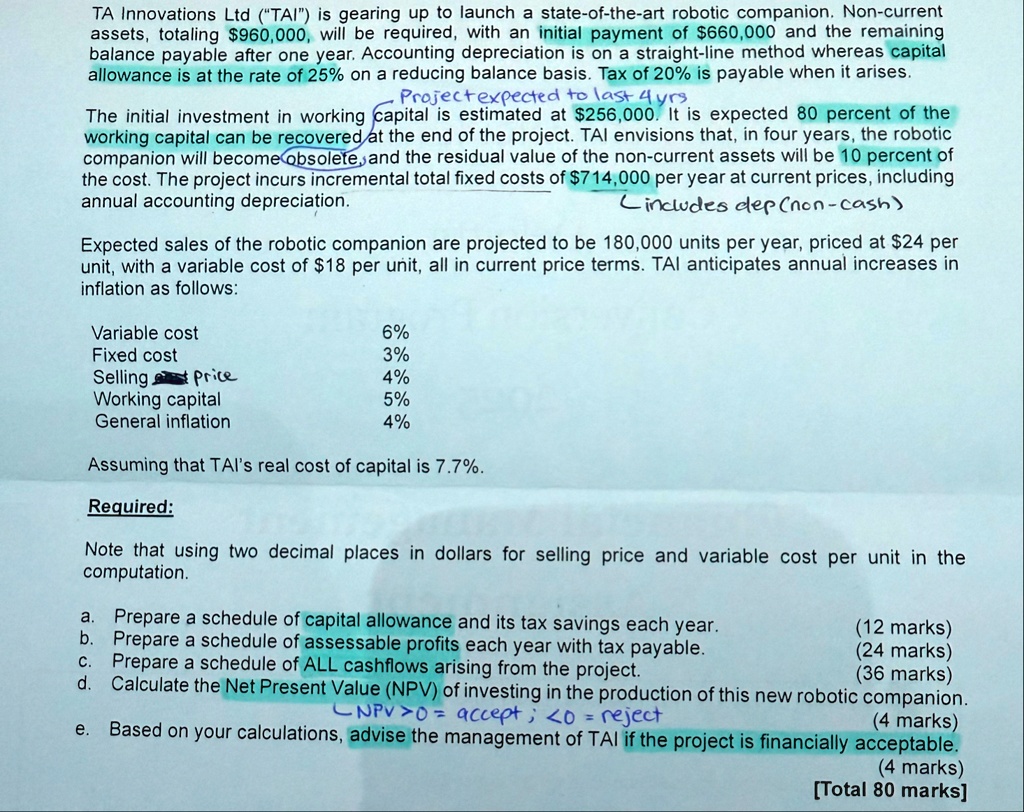
TA Innovations Ltd ("TAI") is gearing up to launch a state-of-the-art robotic companion. Non-current assets, totaling $960,000, will be required, with an initial payment of $660,000 and the remaining balance payable after one year. Accounting depreciation is on a straight-line method whereas capital allowance is at the rate of 25% on a reducing balance basis. Tax of 20% is payable when it arises.
Project expected to last 4 yrs
The initial investment in working capital is estimated at $256,000. It is expected 80 percent of the working capital can be recovered at the end of the project. TAI envisions that, in four years, the robotic companion will become obsolete, and the residual value of the non-current assets will be 10 percent of the cost. The project incurs incremental total fixed costs of $714,000 per year at current prices, including annual accounting depreciation.
Lincludes dep (non-cash)
Expected sales of the robotic companion are projected to be 180,000 units per year, priced at $24 per unit, with a variable cost of $18 per unit, all in current price terms. TAI anticipates annual increases in inflation as follows:
Variable cost 6%
Fixed cost 3%
Selling Price 4%
Working capital 5%
General inflation 4%
Assuming that TAI's real cost of capital is 7.7%.
Required:
Note that using two decimal places in dollars for selling price and variable cost per unit in the computation.
a. Prepare a schedule of capital allowance and its tax savings each year. (12 marks)
b. Prepare a schedule of assessable profits each year with tax payable. (24 marks)
c. Prepare a schedule of ALL cashflows arising from the project. (36 marks)
d. Calculate the Net Present Value (NPV) of investing in the production of this new robotic companion.
LNPV > 0 = accept ; < 0 = reject (4 marks)
e. Based on your calculations, advise the management of TAI if the project is financially acceptable.
(4 marks)
[Total 80 marks]