Please don't use AI I can tell and will dislike answer. Problem 4. Given a bounded region D in R3 it is possible to find a sequence of functions 1(x, y, z), 2(x, y, z), 3(x, y, z), ... such that
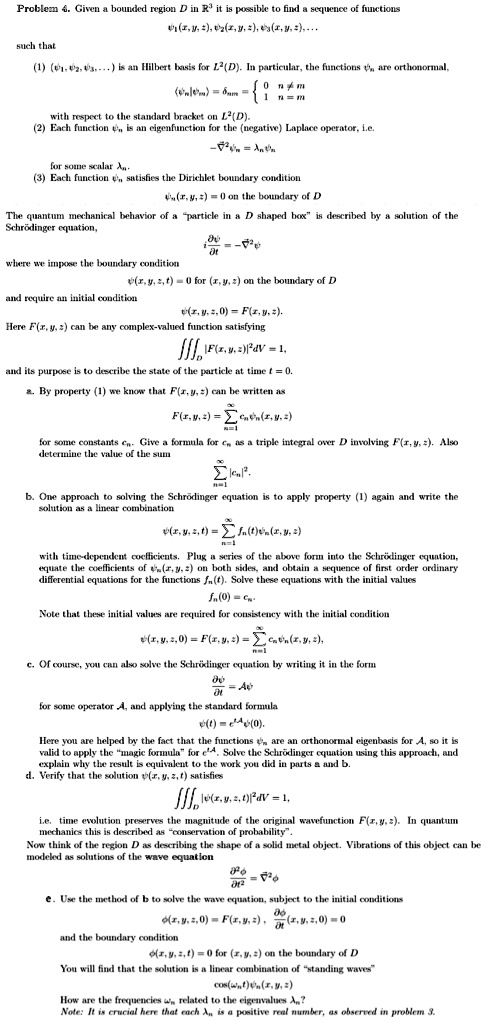
Problem 4. Given a bounded region D in R3 it is possible to find a sequence of functions x, y, z, y, x, y, ... such that
1)(, 3...) is a Hilbert basis for LD. In particular, the functions are orthonormal, nm = am = a yhi m 1n = m
with respect to the standard bracket on L2(D). (2) Each function is an eigenfunction for the (negative) Laplace operator, i.e. = -Xn/ for some scalar A.. (3) Each function satisfies the Dirichlet boundary condition (, y, ) = 0 on the boundary of D
The quantum mechanical behavior of a particle in a D shaped box is described by a solution of the Schrodinger equation, 0 = -2 Ot where we impose the boundary condition (x, y, , t) = 0 for (, y, ) on the boundary of D and require an initial condition x, y, 0 = Fz, y, . Here F(, y, ) can be any complex-valued function satisfying [F, y, 2V = 1, and its purpose is to describe the state of the particle at time t = 0. a. By property (1) we know that F(, y, ) can be written as
Fx, y, = cnzy = 1
for some constants cn. Give a formula for c, as a triple integral over D involving F(, y, ). Also determine the value of the sum
b. One approach to solving the Schrodinger equation is to apply property (1) again and write the solution as a linear combination
x, y, 2, t = fntvnx, y, n = 1
with time-dependent coefficients. Plug a series of the above form into the Schrodinger equation, equate the coefficients of (z, y,) on both sides, and obtain a sequence of first-order ordinary differential equations for the functions f. (t). Solve these equations with the initial values fn0 = cn Note that these initial values are required for consistency with the initial condition
xy, 0 = Fx, y, ) = cn/nx, y, n = 1
c. Of course, you can also solve the Schrodinger equation by writing it in the form
for some operator .A, and applying the standard formula 0 = Here you are helped by the fact that the functions o, are an orthonormal eigenbasis for A, so it is valid to apply the magic formula for eA, Solve the Schrodinger equation using this approach, and explain why the result is equivalent to the work you did in parts a and b. d. Verify that the solution, y, t) satisfies x, y, t2aV = 1, i.e. time evolution preserves the magnitude of the original wavefunction F(z, y,). In quantum mechanics, this is described as conservation of probability. Now think of the region D as describing the shape of a solid metal object. Vibrations of this object can be modeled as solutions of the wave equation 96 = Ot2 e. Use the method of b to solve the wave equation, subject to the initial conditions
and the boundary condition z, y, t = 0 for z, y, = on the boundary of D You will find that the solution is a linear combination of standing waves cos(n)/n(x, y,) How are the frequencies related to the eigenvalues? Note: It is crucial here that each A, is a positive real number, as observed in problem 3.