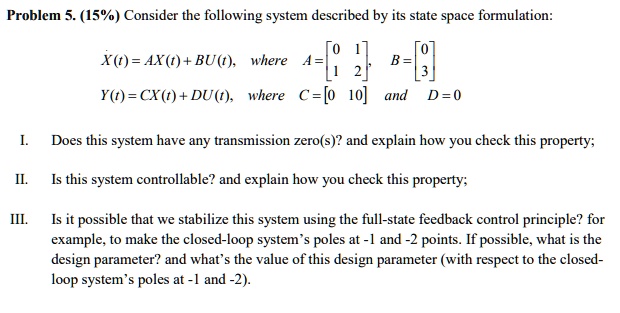
Problem 5. (15%) Consider the following system described by its state space formulation:
\( \dot{X}(t) = AX(t) + BU(t) \), where \( A = \begin{bmatrix} 0 & 1 \\ 1 & 2 \end{bmatrix} \), \( B = \begin{bmatrix} 0 \\ 3 \end{bmatrix} \)
\( Y(t) = CX(t) + DU(t) \), where \( C = \begin{bmatrix} 0 & 10 \end{bmatrix} \) and \( D = 0 \)
I.
Does this system have any transmission zero(s)? and explain how you check this property;
II.
Is this system controllable? and explain how you check this property;
III.
Is it possible that we stabilize this system using the full-state feedback control principle? for
example, to make the closed-loop system's poles at -1 and -2 points. If possible, what is the
design parameter? and what's the value of this design parameter (with respect to the closed-
loop system's poles at -1 and -2).