Based on these comments, explain how this additional
information may help Eastend to better manage its costs. Also,
assuming that these are the only three items, expand the detail
of the flexible budget for materials handling to reveal the cost
of these three resource items for 20,000 moves and 40,000
moves, respectively. You may wish to review the concepts of
flexible, committed, and discretionary resources found in
Chapter 3.
QUESTION TWO
FLE XIBLE BUDGET, OVERHEAD VARIANCES
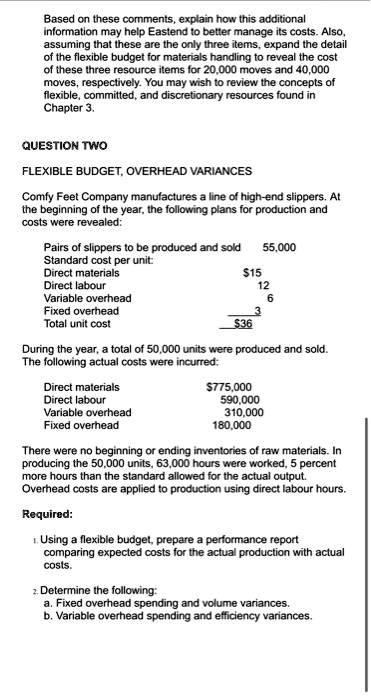
Comfy Feet Company manufactures a line of high-end slippers. At
the beginning of the year, the following plans for production and
costs were revealed:
Pairs of slippers to be produced and sold
Standard cost per unit:
Direct materials
Direct labour
Variable overhead
Fixed overhead
Total unit cost
55,000
$15
12
6
3
$36
During the year, a total of 50,000 units were produced and sold.
The following actual costs were incurred:
Direct materials
Direct labour
Variable overhead
Fixed overhead
$775,000
590,000
310,000
180,000
There were no beginning or ending inventories of raw materials. In
producing the 50,000 units, 63,000 hours were worked, 5 percent
more hours than the standard allowed for the actual output.
Overhead costs are applied to production using direct labour hours.
Required:
1. Using a flexible budget, prepare a performance report
comparing expected costs for the actual production with actual
costs.
2. Determine the following:
a. Fixed overhead spending and volume variances.
b. Variable overhead spending and efficiency variances.