Integers m and n that need only be larger than 2, so 3 of largest.
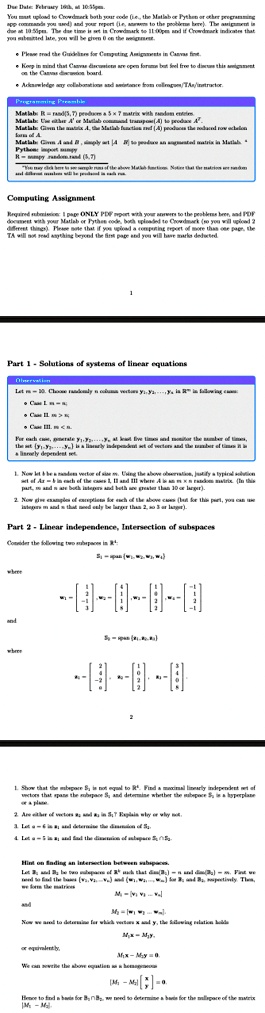
Part 2 - Linear independence, Intersection of subspaces
Consider the following two subspaces in R^(i):
S_(1) = span{w_(1), w_(2), w_(3), w_(4)}
where
w_(1) = [[1], [2], [-1], [3]], w_(2) = [[4], [1], [1], [8]], w_(3) = [[1], [0], [2], [2]], w_(4) = [[-1], [1], [2], [-1]]
and
S_(2) = span{z_(1), z_(2), z_(3)}
where
x_(1) = [[2], [4], [-2], [0]], x_(2) = [[1], [0], [2], [2]], x_(1) = [[8], [4], [0], [8]]
Show that the subspace S_(1) is not equal to R^(d). Find a maximal linearly independent set of
vectors that spans the subspace S_(1) and determine whether the subspace S_(1) is a hyperplane
or a plane.
Let a = 6 in z_(1) and determine the dimension of S_(2).
Let a = 5 in z_(1) and find the dimension of subspace S_(1) ∩ S_(2).
Hint on finding an intersection between subspaces.
Let B_(1) and B_(2) be two subspaces of /bar (R)^(k) such that dim(B_(2)) = n and dim(B_(2)) = m. First we
need to fix the bases {v_(1), v_(2), -v_(2)) and {w_(1), w_(2), dots, w_(n)} for Z_(1) and Z_(2), respectively. Then,
we form the matrices
and
M_(1) = [[v_(1), v_(2), dots, v_(n)]]
M_(2) = [[w_(1), w_(2), dots, w_(n)]]
M_(1)x = M_(2)y,
or equivalently,
M_(1)x - M_(2)y = 0
We can rewrite the above equation as a homogeneous
[M_(1) - M_(2)][[x], [y]] = 0.
Hence to find a basis for B_(2) ∩ B_(2), we need to determine a basis for the nullspace of the matrix (M_(1) - M_(2)).
at 19:56p
Computing Assignment page, s
Part 1 - Solutions of systems of linear equations
Part 2 - Linear independence, Intersection of subspaces