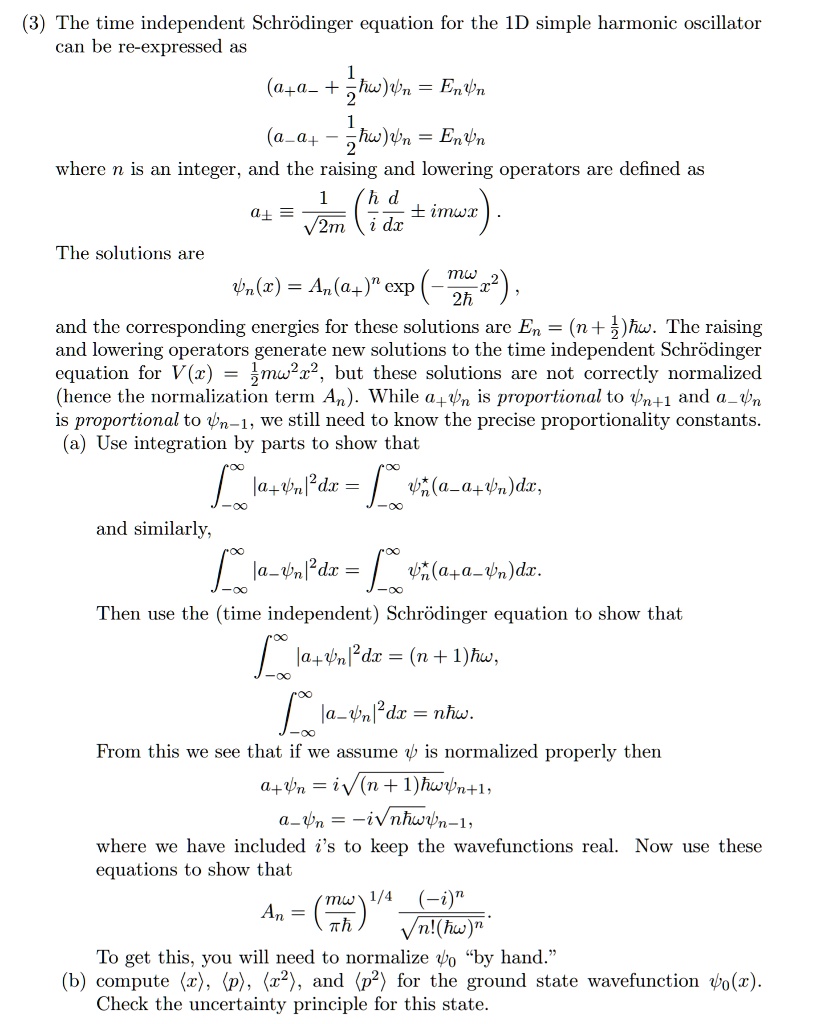
The time independent Schrödinger equation for the 1D simple harmonic oscillator can be re-expressed as
(ħ²/2m) d²ψ/dx² + (1/2) mw²x²ψ = Eψ
where ψ is the wavefunction, m is the mass, w is the angular frequency, x is the position, E is the energy, and ħ is the reduced Planck's constant. The solutions are given by
ψₙ(x) = Aâ‚™ (aâº)â¿ exp(-mw²x²/2ħ)
and the corresponding energies for these solutions are Eâ‚™ = (n + 1/2) ħw. The raising and lowering operators, a⺠and aâ», generate new solutions to the time independent Schrödinger equation for V(x) = mw²x², but these solutions are not correctly normalized (hence the normalization term Aâ‚™). While aâº|ₙ⟩ is proportional to |â‚™+1⟩ and aâ»|ₙ⟩ is proportional to |â‚™-1⟩, we still need to know the precise proportionality constants.
(a) Use integration by parts to show that
∫(aâºaâ‚™)dx = (n + 1) ħw
∫|ψₙ|²dx = nħw.
From this, we see that if we assume ψₙ is normalized properly, then aâº|ₙ⟩ = i√(n+1) |â‚™+1⟩ and aâ»|ₙ⟩ = -i√n |â‚™-1⟩, where we have included i's to keep the wavefunctions real. Now use these equations to show that Aâ‚™ = (mw/πħ)^(1/4) (-i)â¿.
To get this, you will need to normalize ψₙ "by hand."
(b) Compute ⟨x⟩, ⟨p⟩, ⟨x²⟩, and ⟨p²⟩ for the ground state wavefunction ψ₀(x). Check the uncertainty principle for this state.