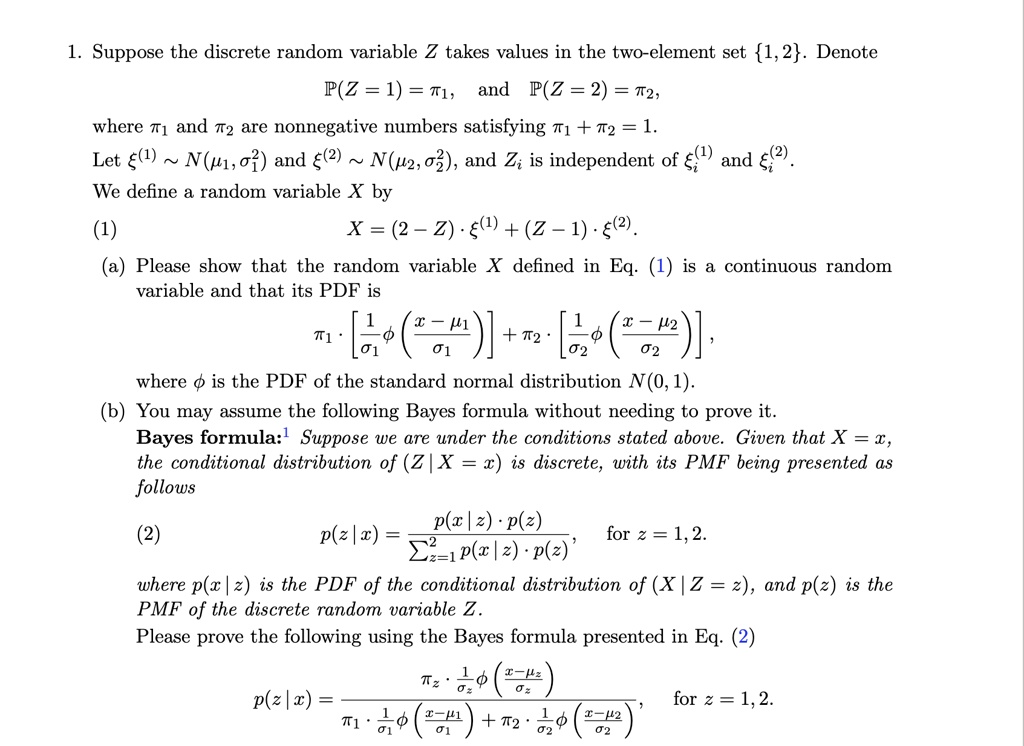
Suppose the discrete random variable Z takes values in the two-element set {1,2}. Denote
P(Z=1)=pi _(1), and ,P(Z=2)=pi _(2),
where pi _(1) and pi _(2) are nonnegative numbers satisfying pi _(1)+pi _(2)=1.
Let xi ^((1))∼N(mu _(1),sigma _(1)^(2)) and xi ^((2))∼N(mu _(2),sigma _(2)^(2)), and Z_(i) is independent of xi _(i)^((1)) and xi _(i)^((2)).
We define a random variable x by
x=(2-Z)*xi ^((1))+(Z-1)*xi ^((2)).
(a) Please show that the random variable x defined in Eq. (1) is a continuous random
variable and that its PDF is
pi _(1)*[(1)/(sigma _(1))phi ((x-mu _(1))/(sigma _(1)))]+pi _(2)*[(1)/(sigma _(2))phi ((x-mu _(2))/(sigma _(2)))],
where phi is the PDF of the standard normal distribution N(0,1).
(b) You may assume the following Bayes formula without needing to prove it.
Bayes formula: ^(1) Suppose we are under the conditions stated above. Given that x=x,
the conditional distribution of (Z|x=x) is discrete, with its PMF being presented as
follows
p(z|x)=(p(x|z)*p(z))/(sum_(z=1)^2 p(x|z)*p(z)), for z=1,2.
where p(x|z) is the PDF of the conditional distribution of (x|Z=z), and p(z) is the
PMF of the discrete random variable Z.
Please prove the following using the Bayes formula presented in Eq. (2)
p(z|x)=(pi _(z)*(1)/(sigma _(z))phi ((x-mu _(z))/(sigma _(z))))/(pi _(1)*(1)/(sigma _(1))phi ((x-mu _(1))/(sigma _(1)))+pi _(2)*(1)/(sigma _(2))phi ((x-mu _(2))/(sigma _(2)))), for z=1,2
1. Suppose the discrete random variable Z takes values in the two-element set {1,2}. Denote
P(Z=1)=T1,and P(Z=2)=T2
where T1 and T2 are nonnegative numbers satisfying T1 + T2 = 1. Let $(1) ~ N(1,?) and (2) ~ N(2,3), and Z; is independent of &(1) and &(2) We define a random variable X by (1) X= (2-Z)1)+(Z-1).2) (a) Please show that the random variable X defined in Eq. (1) is a continuous random variable and that its PDF is
where is the PDF of the standard normal distribution N(0,1)
(b) You may assume the following Bayes formula without needing to prove it Bayes formula:1 Suppose we are under the conditions stated above. Given that X = x, the conditional distribution of (Z|X = x) is discrete, with its PMF being presented as follows
p(x|z).p(z)
(2)
p(z|x)= D2=1P(x|z)p(z)
for z =1,2.
where p(x|z) is the PDF of the conditional distribution of (X|Z = z), and p(z) is the PMF of the discrete random variable Z. Please prove the following using the Bayes formula presented in Eq. (2)
Tz
p(z|x)= T1
Uz
for z = 1, 2.
x-1 1
-2 2
O2