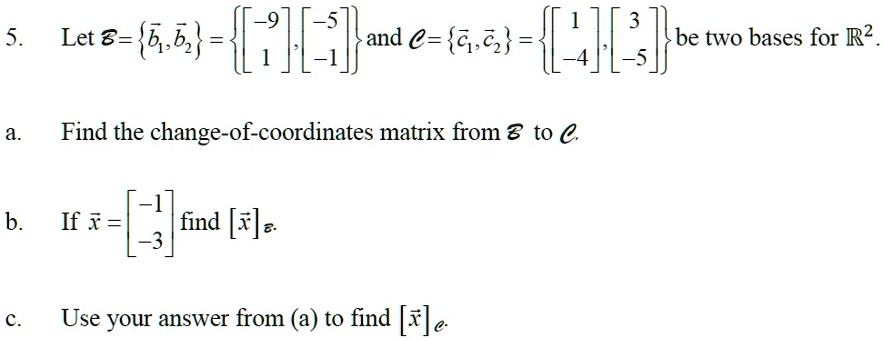
5. Let \(\mathcal{B} = \{\vec{b}_1, \vec{b}_2\} = \left\{ \begin{bmatrix} -9\\1 \end{bmatrix}, \begin{bmatrix} -5\\-1 \end{bmatrix} \right\}\) and \(\mathcal{C} = \{\vec{c}_1, \vec{c}_2\} = \left\{ \begin{bmatrix} 1\\-4 \end{bmatrix}, \begin{bmatrix} 3\\-5 \end{bmatrix} \right\}\) be two bases for \(\mathbb{R}^2\).
a. Find the change-of-coordinates matrix from \(\mathcal{B}\) to \(\mathcal{C}\).
b. If \(\vec{x} = \begin{bmatrix} -1\\-3 \end{bmatrix}\), find \([\vec{x}]_\mathcal{B}\).
c. Use your answer from (a) to find \([\vec{x}]_\mathcal{C}\)