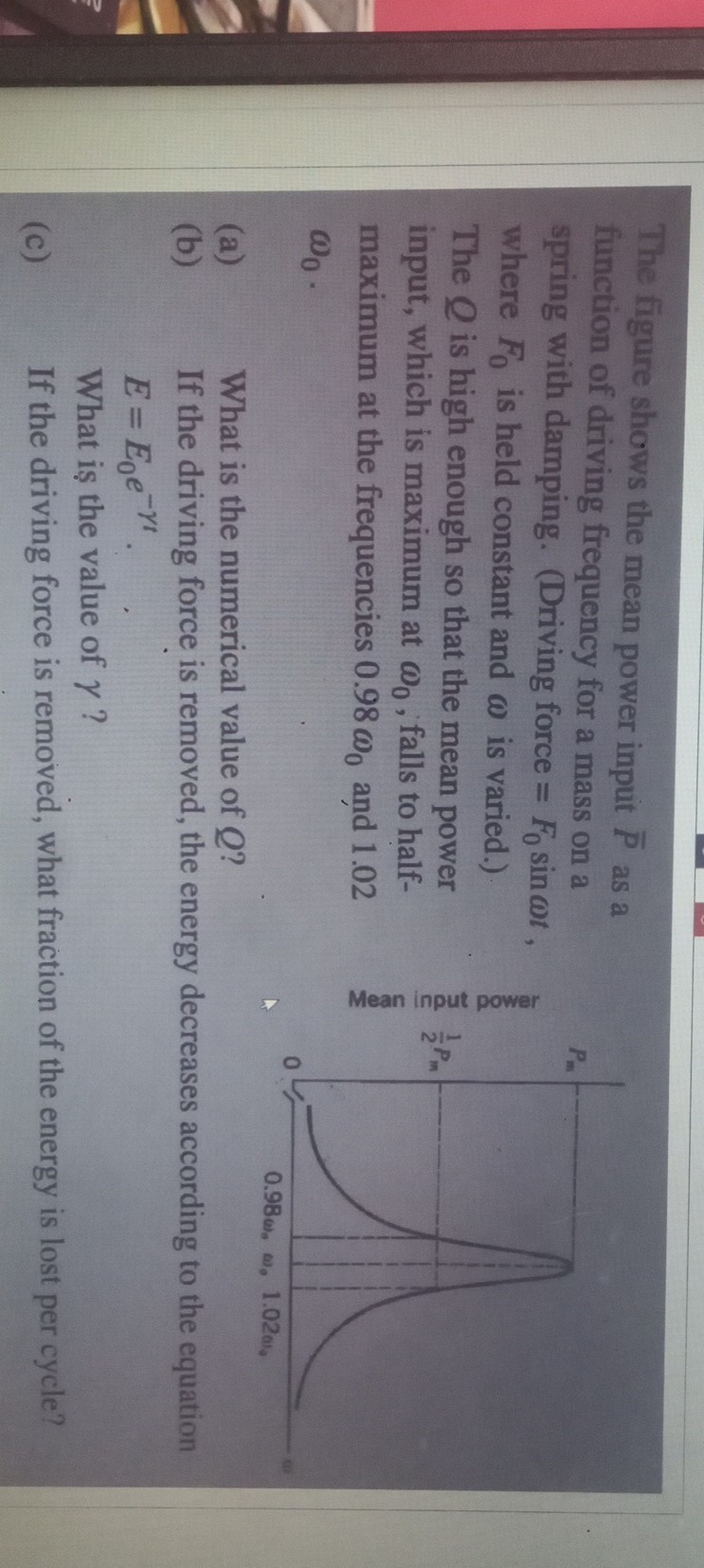
The figure shows the mean power input \( \bar{P} \) as a function of driving frequency for a mass on a spring with damping. (Driving force \( =F_{0} \sin \omega t \), where \( F_{0} \) is held constant and \( \omega \) is varied.) The \( Q \) is high enough so that the mean power input, which is maximum at \( \omega_{0} \), falls to halfmaximum at the frequencies \( 0.98 \omega_{0} \) and 1.02 \( \omega_{0} \).
(a) What is the numerical value of \( Q \) ?
(b) If the driving force is removed, the energy decreases according to the equation \( E=E_{0} e^{-\gamma t} \).
What is the value of \( \gamma \) ?
(c) If the driving force is removed, what fraction of the energy is lost per cycle?