6:19 PM
58
1. Write the structural formula for each of the following:
(a) m-xylene
(b) 3,5-dinitrobenzoic acid
(c) 2,4,6-trinitrophenol
(d) Chlorotriphenylmethane
(e) p-ethylaniline
(f) 4-n-butylbenzenesulfonic acid
(g) 1-chloro-2-(2-chloropropyl)benzene
(h) \( m \)-bromo-anisole
(i) Benzyl alcohol
(j) 4-Phenyl-1-butene
(k) \( o \) - \( p \) Cresol
(l) 2-Phenylethanol
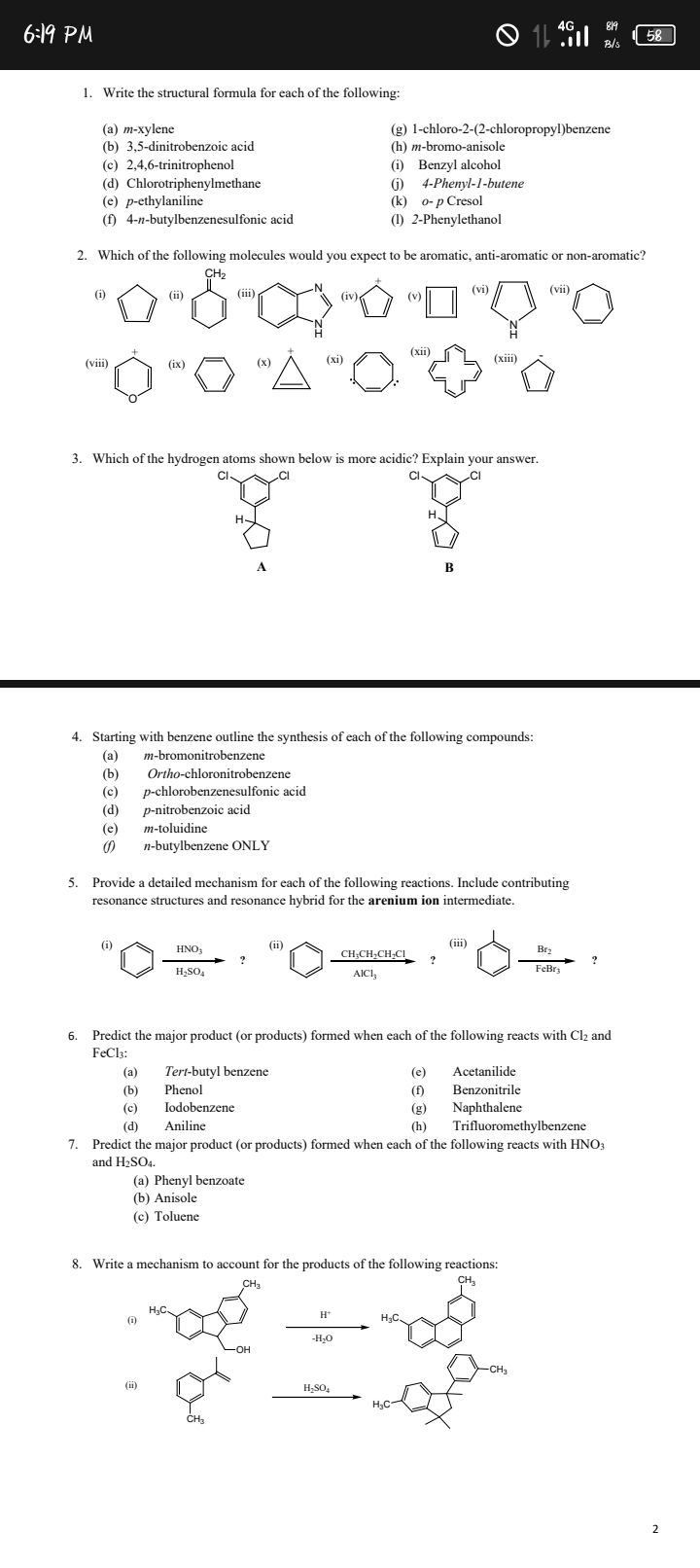
2. Which of the following molecules would you expect to be aromatic, anti-aromatic or non-aromatic?
(i)
(ii)
(iii)
(v)
(vi)
(vii)
(viii)
(ix)
(x)
(xi)
(xiii)
(xiii)
3. Which of the hydrogen atoms shown below is more acidic? Explain your answer.
A
B
4. Starting with benzene outline the synthesis of each of the following compounds:
(a) \( m \)-bromonitrobenzene
(b) Ortho-chloronitrobenzene
(c) p-chlorobenzenesulfonic acid
(d) p-nitrobenzoic acid
(e) \( m \)-toluidine
(f) n-butylbenzene ONLY
5. Provide a detailed mechanism for each of the following reactions. Include contributing resonance structures and resonance hybrid for the arenium ion intermediate.
(i)
(ii)
(iii)
6. Predict the major product (or products) formed when each of the following reacts with \( \mathrm{Cl}_{2} \) and \( \mathrm{FeCl}_{3} \) :
(a) Tert-butyl benzene
(e) Acetanilide
(b) Phenol
(f) Benzonitrile
(c) Iodobenzene
(g) Naphthalene
(d) Aniline
(h) Trifluoromethylbenzene
7. Predict the major product (or products) formed when each of the following reacts with \( \mathrm{HNO}_{3} \) and \( \mathrm{H}_{2} \mathrm{SO}_{4} \).
(a) Phenyl benzoate
(b) Anisole
(c) Toluene
8. Write a mechanism to account for the products of the following reactions:
(i)
(ii)
2