A1.2
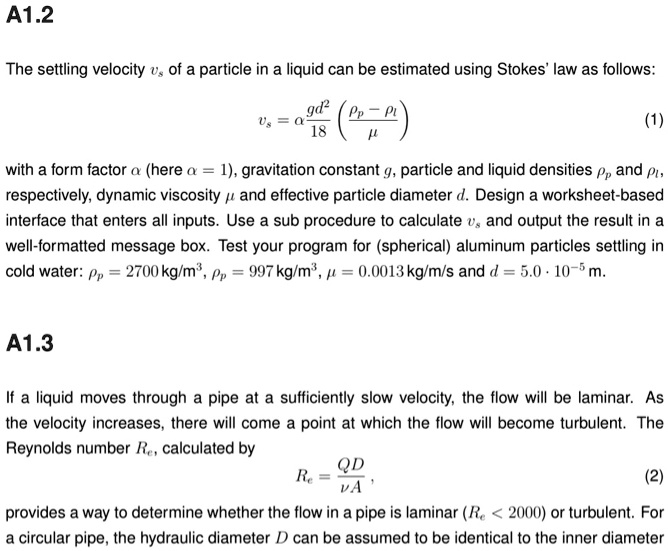
The settling velocity $v_s$ of a particle in a liquid can be estimated using Stokes' law as follows:
$\frac{gd^2}{18} \left(\frac{\rho_p - \rho_l}{\mu}\right)$ (1)
with a form factor $\alpha$ (here $\alpha = 1$), gravitation constant $g$, particle and liquid densities $\rho_p$ and $\rho_l$,
respectively, dynamic viscosity $\mu$ and effective particle diameter $d$. Design a worksheet-based
interface that enters all inputs. Use a sub procedure to calculate $v_s$ and output the result in a
well-formatted message box. Test your program for (spherical) aluminum particles settling in
cold water: $\rho_p = 2700 \text{ kg/m}^3$, $\rho_l = 997 \text{ kg/m}^3$, $\mu = 0.0013 \text{ kg/m/s}$ and $d = 5.0 \cdot 10^{-5} \text{ m}$.
A1.3
If a liquid moves through a pipe at a sufficiently slow velocity, the flow will be laminar. As
the velocity increases, there will come a point at which the flow will become turbulent. The
Reynolds number $Re$, calculated by
$Re = \frac{QD}{\nu A}$ (2)
provides a way to determine whether the flow in a pipe is laminar ($Re < 2000$) or turbulent. For
a circular pipe, the hydraulic diameter $D$ can be assumed to be identical to the inner diameter