1. You are examining the DNA sequences from three species.
Specifically, you are examining sequences from the intron
of a gene. Species A and B are most closely related, while
C is more distantly related. The sequences of A and B differ
by 18 base pairs, A and C differ by 26 base pairs, and B and
C differ by 28 base pairs. Fossils show that species A and B
diverged about 1.2 Mya, but there is no fossil evidence as
to when the most recent common ancestor of all three
species lived. Use the genetic data to estimate that date.
2. The logic of the McDonald-Kreitman test is based on the
ratio of the number of sites that are different between two
species and the number of sites that are polymorphic within
one of those species. If a locus is evolving neutrally, this
ratio is expected to be the same for synonymous and
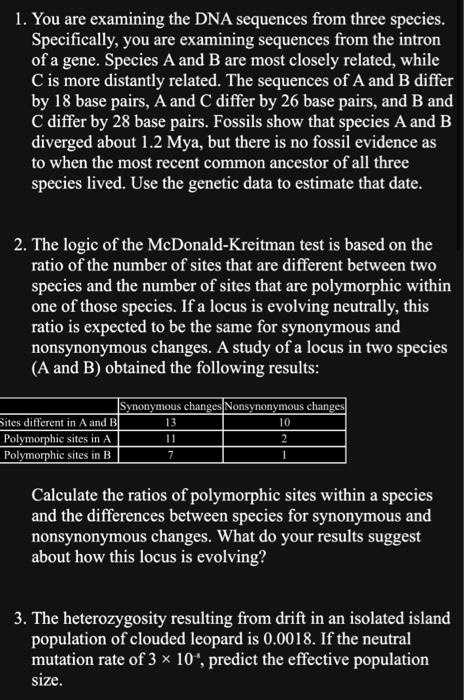
nonsynonymous changes. A study of a locus in two species
(A and B) obtained the following results:
\begin{tabular}{|l|c|c|}
\hline
& Synonymous changes & Nonsynonymous changes \\
\hline
Sites different in A and B & 13 & 10 \\
Polymorphic sites in A & 11 & 2 \\
Polymorphic sites in B & 7 & 1 \\
\hline
\end{tabular}
Calculate the ratios of polymorphic sites within a species
and the differences between species for synonymous and
nonsynonymous changes. What do your results suggest
about how this locus is evolving?
3. The heterozygosity resulting from drift in an isolated island
population of clouded leopard is 0.0018. If the neutral
mutation rate of $3 \times 10^{-8}$, predict the effective population
size.