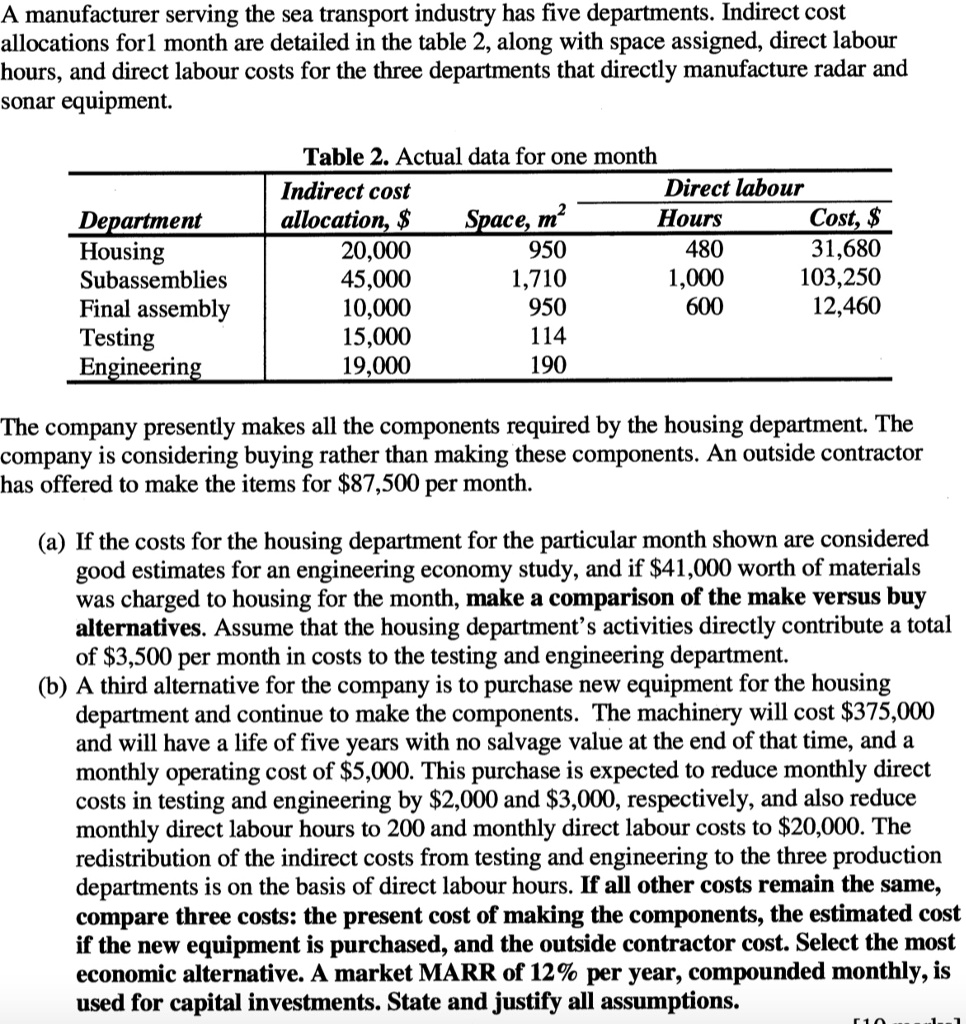
A manufacturer serving the sea transport industry has five departments. Indirect cost allocations forl month are detailed in the table 2, along with space assigned, direct labour hours, and direct labour costs for the three departments that directly manufacture radar and sonar equipment.
Table 2. Actual data for one month
Indirect cost allocation, $ 20,000 45,000 10,000 15,000 19,000
Direct labour Hours Cost, $ 480 31,680 1,000 103,250 600 12,460
Department Housing Subassemblies Final assembly Testing Engineering
Space, m2 950 1,710 950 114 190
The company presently makes all the components required by the housing department. The company is considering buying rather than making these components. An outside contractor has offered to make the items for $87,500 per month.
(a) If the costs for the housing department for the particular month shown are considered good estimates for an engineering economy study, and if $41,000 worth of materials was charged to housing for the month, make a comparison of the make versus buy alternatives. Assume that the housing department's activities directly contribute a total of $3,500 per month in costs to the testing and engineering department. (b) A third alternative for the company is to purchase new equipment for the housing department and continue to make the components. The machinery will cost $375,000 and will have a life of five years with no salvage value at the end of that time, and a monthly operating cost of $5,000. This purchase is expected to reduce monthly direct costs in testing and engineering by $2,000 and $3,000, respectively, and also reduce monthly direct labour hours to 200 and monthly direct labour costs to $20,000. The redistribution of the indirect costs from testing and engineering to the three production departments is on the basis of direct labour hours. If all other costs remain the same, compare three costs: the present cost of making the components, the estimated cost if the new equipment is purchased, and the outside contractor cost. Select the most economic alternative. A market MARR of 12 % per year, compounded monthly, is used for capital investments. State and justify all assumptions.