Ace - AI Tutor
Ask Our Educators
Textbooks
My Library
Flashcards
Scribe - AI Notes
Notes & Exams
Download App
tyler rint

tyler r.

Divider

Viewed Questions

A large tank has a plastic window on one wall that is designed to withstand a force of 90,000 N. The square window is 2 m on a side, and its lower edge is 1 m from the bottom of the tank.
a. If the tank is filled to a depth of 4 m, will the window with-stand the resulting force?
b. What is the maximum depth to which the tank can be filled without the window failing?

A large tank has a plastic window on one wall that is designed to withstand a force of 90,000 N. The square window is 2 m on a side, and its lower edge is 1 m from the bottom of the tank. a. If the tank is filled to a depth of 4 m, will the window with-stand the resulting force? b. What is the maximum depth to which the tank can be filled without the window failing?

Calculus: Early Transcendentals

Applications of Integration

Physical Applications

Questions asked

ANSWERED

Khoi V verified

Numerade educator

Learning Target 14: Given an infinite series, ( I ) can check the conditions required for application of the Integral Test. When it is applicable, I can use the Integral Test to determine the convergence of an infinite series. I can compute the value of an integral to estimate the value of an infinite series. 1. Using the integral test, find the positive values of ( p ) for which the series ( sum_{k=2}^{infty} frac{1}{k(ln (k))^{p}} ) converges. Show your work and explain your reasoning.

View Answer
divider
ANSWERED

William Semus verified

Numerade educator

Learning Target 19: I can represent a function with a power series in the case that the function can be related to the sum of a convergent geometric power series. I can obtain representations of related functions by differentiating or integrating 1. Consider the function arctan(2x). (a) State the derivative of arctan(2x). (Remember the chain rule!) You don't need an elaborate derivation. Just state it. (b) Find a power series representation for the derivative you computed in the previous part by using the power series representation for 1 / (1 - ?) (c) Integrate that power series from 0 to x to obtain a power series representation for arctan(2x). (Use t as the dummy integration vvariable, since you are letting the upper limit of integration be the variable x.)

View Answer
divider
ANSWERED

Joseph David verified

Numerade educator

Learning Target 16: I can identify Alternating Series and check the conditions required for the application of the Alternating Series Test. I can use the Alternating Series Test to determine the convergence of an infinite series. I can estimate the value of an alternating series and the error of its partial sums. I can test an infinite series for absolute convergence and for conditional convergence. 1. Consider the series ( sum_{k=1}^{infty}(-1)^{k-1} frac{4}{2 k-1} ) (a) Show that this series satisfies the criteria for the Alternating Series Test (AST) and therefore converges. (b) Approximate the sum of the series using the first six terms. That is, using the 6th partial sum, use the Alternating Series Remainder to find ( a ) and ( b ) such that ( a leq S leq b ), where ( S ) is the sum of the series.

View Answer
divider
ANSWERED

Joseph David verified

Numerade educator

Learning Target 12 (CORE): I can determine, with sufficient justification, whether an infinite sequence diverges or converges. When an infinite sequence converges, I can determine that limit. I can apply valid reasoning to determine whether a sequence converges when given knowledge about a similar sequence. 1. Consider the sequence ( left{a_{k} ight}_{k=1}^{infty} ) where ( a_{k}=frac{1 cdot 3 cdot 5 cdots(2 k-1)}{10^{k}} ). Determine if this sequence is monotonic increasing or monotonic decreasing, or eventually monotonic increasing or eventually monotonic decreasing.

View Answer
divider
ANSWERED

Supreeta N verified

Numerade educator

1. Consider the function [ F(x)=int_{0}^{x} frac{1}{1+t^{2}} d t+int_{0}^{1 / x} frac{1}{1+t^{2}} d t ] (a) Using the Second Fundamental Theorem of Calculus, show that ( F(x) ) is constant on ( (0, infty) ) and on ( (-infty, 0) ) (b) Find the constant value(s) of ( F(x) ). (You don't need the Second Fundamental Theorem for this. Just think about what it means for ( F(x) ) to be constant on an interval.)

View Answer
divider
ANSWERED

Supreeta N verified

Numerade educator

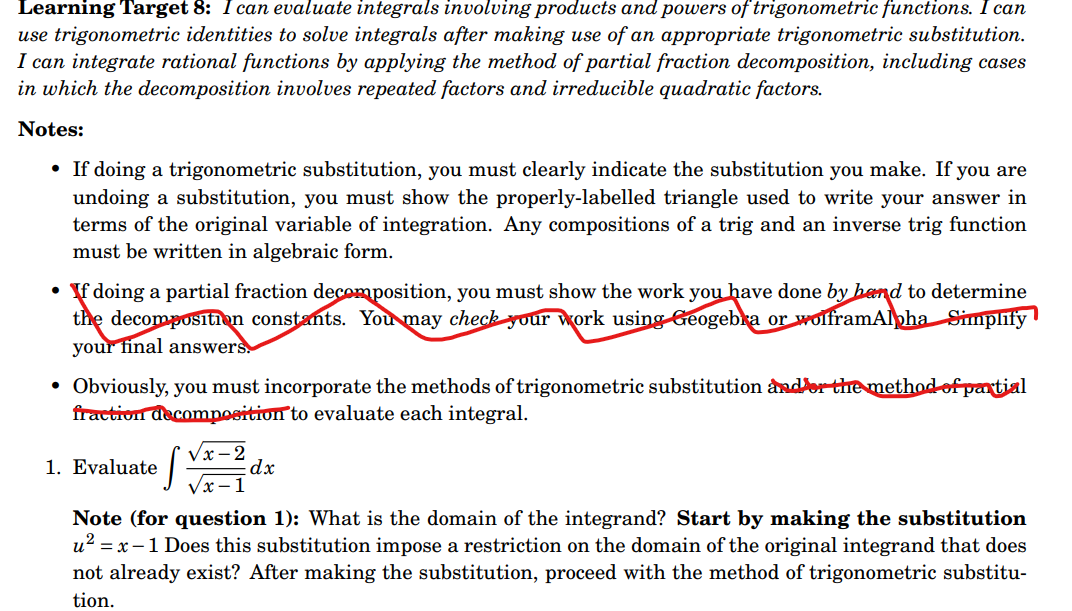
Learning Target 8: I can evaluate integrals involving products and powers of trigonometric functions. I can use trigonometric identities to solve integrals after making use of an appropriate trigonometric substitution. I can integrate rational functions by applying the method of partial fraction decomposition, including cases in which the decomposition involves repeated factors and irreducible quadratic factors. Notes: • If doing a trigonometric substitution, you must clearly indicate the substitution you make. If you are undoing a substitution, you must show the properly-labelled triangle used to write your answer in terms of the original variable of integration. Any compositions of a trig and an inverse trig function must be written in algebraic form. • If doing a partial fraction decomposition, you must show the work you have done by hand to determine the decomposition constants. You may check your work using Geogebra or WolframAlpha. Simplify your final answers. • Obviously, you must incorporate the methods of trigonometric substitution and/or the method of partial fraction decomposition to evaluate each integral. 1. Evaluate ? ?(x - 2) / ?(x - 1) dx Note (for question 1): What is the domain of the integrand? Start by making the substitution u² = x - 1 Does this substitution impose a restriction on the domain of the original integrand that does not already exist? After making the substitution, proceed with the method of trigonometric substitution.
View Answer
divider