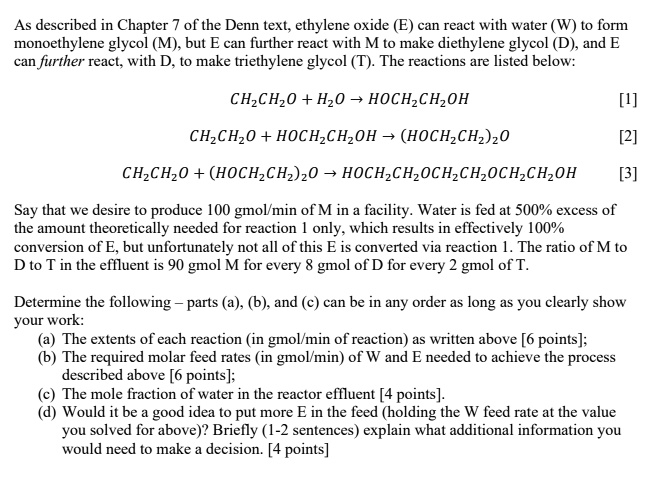
As described in Chapter 7 of the Denn text, ethylene oxide (E) can react with water (W) to form
monoethylene glycol (M), but E can further react with M to make diethylene glycol (D), and E
can further react, with D, to make triethylene glycol (T). The reactions are listed below:
$CH_2CH_2O + H_2O \rightarrow HOCH_2CH_2OH$
$CH_2CH_2O + HOCH_2CH_2OH \rightarrow (HOCH_2CH_2)_2O$
$CH_2CH_2O + (HOCH_2CH_2)_2O \rightarrow HOCH_2CH_2OCH_2CH_2OCH_2CH_2OH$
[1]
[2]
[3]
Say that we desire to produce 100 gmol/min of M in a facility. Water is fed at 500% excess of
the amount theoretically needed for reaction 1 only, which results in effectively 100%
conversion of E, but unfortunately not all of this E is converted via reaction 1. The ratio of M to
D to T in the effluent is 90 gmol M for every 8 gmol of D for every 2 gmol of T.
Determine the following - parts (a), (b), and (c) can be in any order as long as you clearly show
your work:
(a) The extents of each reaction (in gmol/min of reaction) as written above [6 points];
(b) The required molar feed rates (in gmol/min) of W and E needed to achieve the process
described above [6 points];
(c) The mole fraction of water in the reactor effluent [4 points].
(d) Would it be a good idea to put more E in the feed (holding the W feed rate at the value
you solved for above)? Briefly (1-2 sentences) explain what additional information you
would need to make a decision. [4 points]