The simple Michaelis-Menten model does not deal with all aspects of enzyme-catalyzed
reactions. The model must be modified to treat the phenomena of inhibition.
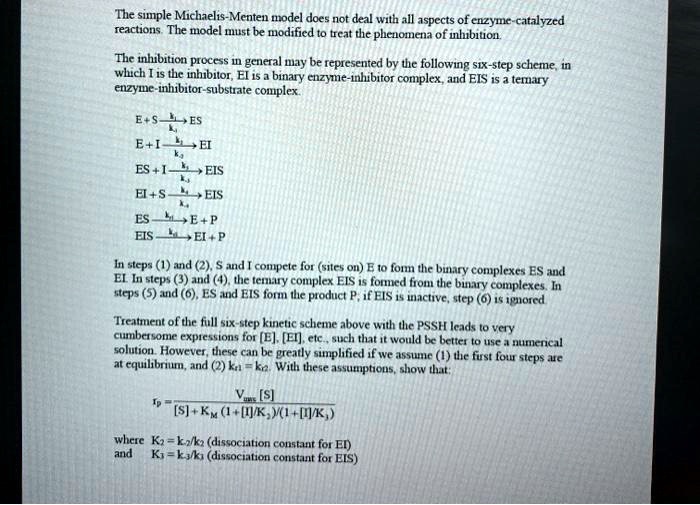
The inhibition process in general may be represented by the following six-step scheme, in
which I is the inhibitor, EI is a binary enzyme-inhibitor complex, and EIS is a temary
enzyme-inhibitor-substrate complex.
E + S \stackrel{k_1}{\rightleftharpoons} ES
E + I \stackrel{k_2}{\rightleftharpoons} EI
ES + I \stackrel{k_3}{\rightleftharpoons} EIS
EI + S \stackrel{k_4}{\rightleftharpoons} EIS
ES \stackrel{k_5}{\longrightarrow} E + P
EIS \stackrel{k_6}{\longrightarrow} EI + P
In steps (1) and (2), S and I compete for (sites on) E to form the binary complexes ES and
EI. In steps (3) and (4), the ternary complex EIS is formed from the binary complexes. In
steps (5) and (6), ES and EIS form the product P; if EIS is inactive, step (6) is ignored.
Treatment of the full six-step kinetic scheme above with the PSSH leads to very
cumbersome expressions for [E], [EI], etc., such that it would be better to use a numerical
solution. However, these can be greatly simplified if we assume (1) the first four steps are
at equilibrium, and (2) $k_1 = k_2$. With these assumptions, show that:
$v_p = \frac{V_{max}[S]}{[S] + K_m(1 + [I]/K_2)(1 + [I]/K_3)}$
where $K_2 = k_2/k_2$ (dissociation constant for EI)
and $K_3 = k_3/k_3$ (dissociation constant for EIS)