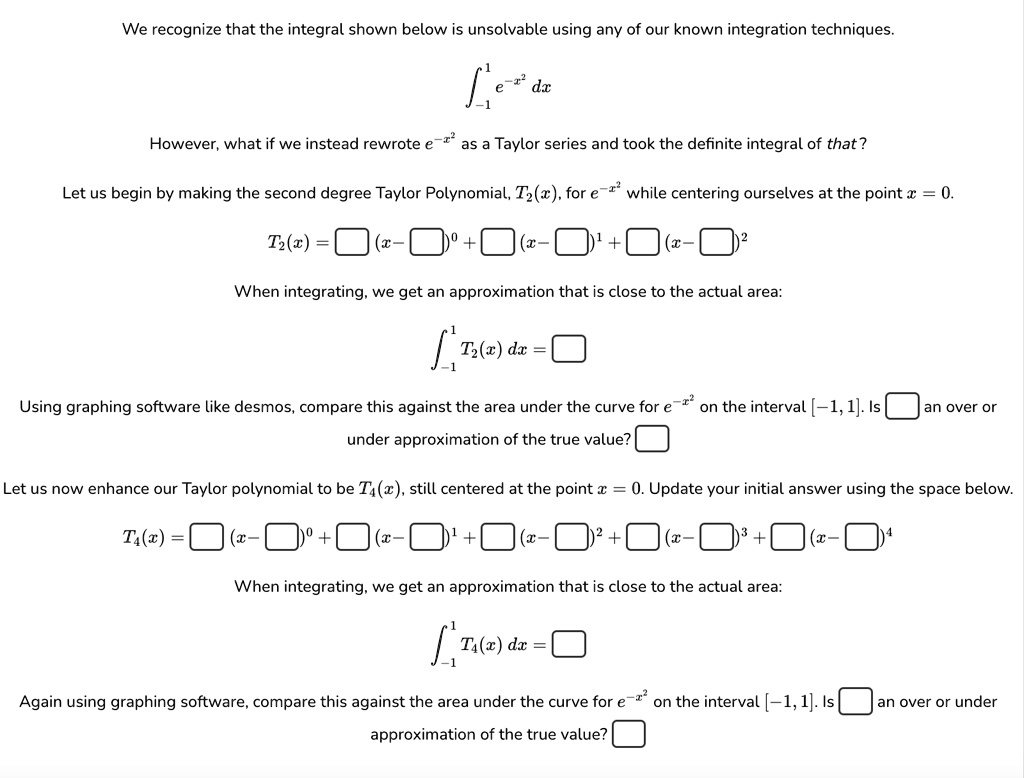
We recognize that the integral shown below is unsolvable using any of our known integration techniques.
$$\int_{-1}^{1} e^{-x^2} dx$$
However, what if we instead rewrote $$e^{-x^2}$$ as a Taylor series and took the definite integral of that?
Let us begin by making the second degree Taylor Polynomial, $$T_2(x)$$, for $$e^{-x^2}$$ while centering ourselves at the point $$x = 0$$.
$$T_2(x) = \boxed{1} (x - \boxed{0})^0 + \boxed{-1} (x - \boxed{0})^2$$
When integrating, we get an approximation that is close to the actual area:
$$\int_{-1}^{1} T_2(x) dx = \boxed{1.333}$$
Using graphing software like desmos, compare this against the area under the curve for $$e^{-x^2}$$ on the interval $$[-1, 1]$$. Is $$\boxed{under}$$ an over or under approximation of the true value?
Let us now enhance our Taylor polynomial to be $$T_4(x)$$, still centered at the point $$x = 0$$. Update your initial answer using the space below.
$$T_4(x) = \boxed{1} (x - \boxed{0})^0 + \boxed{-1} (x - \boxed{0})^2 + \boxed{\frac{1}{2}} (x - \boxed{0})^4$$
When integrating, we get an approximation that is close to the actual area:
$$\int_{-1}^{1} T_4(x) dx = \boxed{1.466}$$
Again using graphing software, compare this against the area under the curve for $$e^{-x^2}$$ on the interval $$[-1, 1]$$. Is $$\boxed{under}$$ an over or under approximation of the true value?