Ace - AI Tutor
Ask Our Educators
Textbooks
My Library
Flashcards
Scribe - AI Notes
Notes & Exams
Download App
clayton hayes

clayton h.

Divider

Questions asked

BEST MATCH

Writing about what makes you different from your family and friends likely primes a(n) [ Select ] ["interdependent self-construal", "independent self-construal", "self-verification motive", "self-enhancement motive"] , while writing about what you have in common with your family and friends likely primes a(n) [ Select ] ["interdependent self-construal", "self-enhancement motive", "self-verification motive", "independent self-construal"] .

View Answer
divider
BEST MATCH

The total work done to an object is always equal to what quantity?

View Answer
divider
BEST MATCH

Explain why each of the following integrals is improper. (a) $$ \int_{1}^{5} \frac{dx}{x-4} $$ $$ \text{Since the function } y = \frac{1}{x-4} \text{ has an infinite discontinuity at } x = 4, \text{ the integral is a Type 1 improper integral.} $$ $$ \text{Since the function } y = \frac{1}{x-4} \text{ has an infinite discontinuity at } x = 1, \text{ the integral is a Type 2 improper integral.} $$ $$ \text{Since the function } y = \frac{1}{x-4} \text{ has an infinite discontinuity at } x = 4, \text{ the integral is a Type 2 improper integral.} $$ $$ \text{Since the integral } \int_{1}^{5} \frac{dx}{x-4} \text{ has an infinite interval of integration, it is a Type 1 improper integral.} $$ $$ \text{Since the integral } \int_{1}^{5} \frac{dx}{x-4} \text{ has an infinite interval of integration, it is a Type 2 improper integral.} $$

View Answer
divider
BEST MATCH

in the synthesis of K3[Fe(C2O4)3], how does c2o4 replace Cl ions

View Answer
divider
BEST MATCH

Question 80 Lyase joins two things together thereby producing polymers True False

View Answer
divider
BEST MATCH

Evaluate: \[ \int_{3}^{13} \frac{(\ln x)^{5}}{x} d x= \] \( \qquad \)

View Answer
divider
BEST MATCH

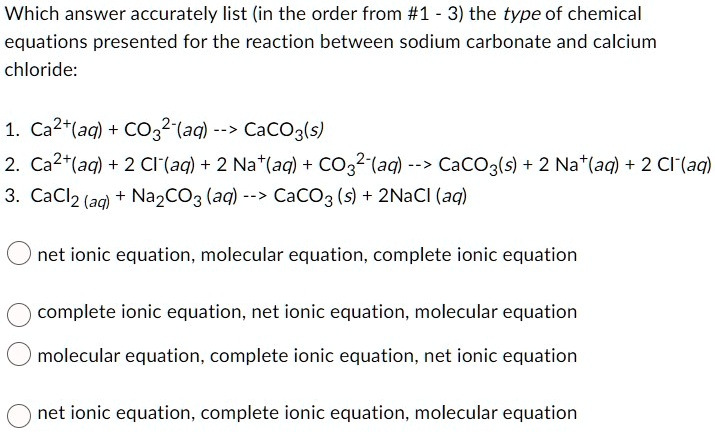
Which answer accurately list (in the order from #1 - 3) the type of chemical equations presented for the reaction between sodium carbonate and calcium chloride: 1. Ca$^{2+}$(aq) + CO$_3$$^{2-}$(aq) --> CaCO$_3$(s) 2. Ca$^{2+}$(aq) + 2 Cl$^{-}$(aq) + 2 Na$^{+}$(aq) + CO$_3$$^{2-}$(aq) --> CaCO$_3$(s) + 2 Na$^{+}$(aq) + 2 Cl$^{-}$(aq) 3. CaCl$_2$ (aq) + Na$_2$CO$_3$ (aq) --> CaCO$_3$ (s) + 2NaCl (aq) net ionic equation, molecular equation, complete ionic equation complete ionic equation, net ionic equation, molecular equation molecular equation, complete ionic equation, net ionic equation net ionic equation, complete ionic equation, molecular equation
View Answer
divider
BEST MATCH

(1 point) Use the formulae $\sum_{j=1}^{N} j = \frac{N(N+1)}{2}$ $\sum_{j=1}^{N} j^2 = \frac{N(N+1)(2N+1)}{6}$ to evaluate the sums $S_N = \sum_{j=1}^{N} (10 + \frac{7j}{N})$ $T_N = \sum_{j=1}^{N} (5 - \frac{6j}{N})^2$. $S_N = $ $T_N = $ Find the limits $S = \lim_{N \to \infty} \frac{1}{N} \sum_{j=1}^{N} (10 + \frac{7j}{N})$ $T = \lim_{N \to \infty} \frac{1}{N} \sum_{j=1}^{N} (5 - \frac{6j}{N})^2$. $S = 13.5$ $T = $

View Answer
divider
BEST MATCH

"The government's right to coerce" implies: None of these Both Taxation and Regulation Taxation Regulation

View Answer
divider
BEST MATCH

(C) (0.75 points) Shade the domain of \(z = \ln\left(5 - \left(x - y\right)\right)\). (D) (0.75 points) Shade the domain of \(z = \sqrt{x - y - 5}\).

View Answer
divider