Ace - AI Tutor
Ask Our Educators
Textbooks
My Library
Flashcards
Scribe - AI Notes
Notes & Exams
Download App
clayton williams

clayton w.

Divider

Questions asked

BEST MATCH

Quiz The three main tools of monetary policy are Multiple Choice interest on reserve balances, open-market operations, and changing the federal funds rate. tax-rate changes, changes in government expenditures, and open-market operations. open-market operations, forward guidance, and changing the administered interest rates. changes in government expenditures, changing the discount rate, and forward guidance. Prev 1 of 14 Next Saved Help Save &

View Answer
divider
BEST MATCH

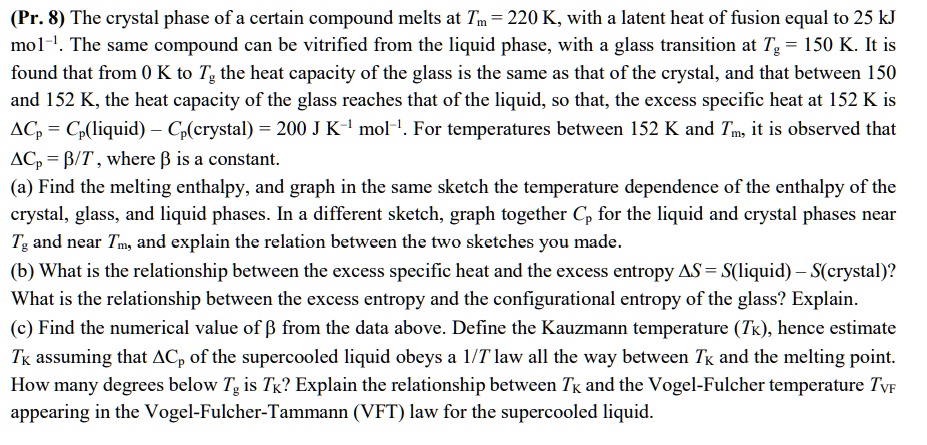
(Pr. 8) The crystal phase of a certain compound melts at T_(m)=220K, with a latent heat of fusion equal to 25 kJ mol^(-1). The same compound can be vitrified from the liquid phase, with a glass transition at T_(g)=150K. It is found that from 0 K to T_(g) the heat capacity of the glass is the same as that of the crystal, and that between 150 and 152 K , the heat capacity of the glass reaches that of the liquid, so that, the excess specific heat at 152 K is \Delta C_(p)=C_(p) (liquid) -C_(p) (crystal) =200JK^(-1)mol^(-1). For temperatures between 152 K and T_(m), it is observed that \Delta C_(p)=(\beta )/(T), where \beta is a constant. (a) Find the melting enthalpy, and graph in the same sketch the temperature dependence of the enthalpy of the crystal, glass, and liquid phases. In a different sketch, graph together C_(p) for the liquid and crystal phases near T_(g) and near T_(m), and explain the relation between the two sketches you made. (b) What is the relationship between the excess specific heat and the excess entropy \Delta S=S (liquid) -S (crystal)? What is the relationship between the excess entropy and the configurational entropy of the glass? Explain. (c) Find the numerical value of \beta T_(K) T_(K) assuming that \Delta C_(p) of the supercooled liquid obeys a (1)/(T) law all the way between T_(K) and the melting point. How many degrees below T_(g) is T_(K) ? Explain the relationship between T_(K) and the Vogel-Fulcher temperature T_(VF) appearin
View Answer
divider
BEST MATCH

Question : Which of the following is a potential problem due to the use of lubrication oil? A. Frictional wear in compressor components B. Excessive vibration in a cooling water circulation pump C. Malfunction of safety relief valves D. A decrease in condenser heat transfer E. Frictional wear in compressor motors

View Answer
divider
BEST MATCH

Briefly describe a feedback control system for the regulation of another important physiological variable

View Answer
divider
BEST MATCH

What happened to raw material prices after the Korean War ended?

View Answer
divider
BEST MATCH

What was the primary purpose of the Proclamation of 1763? to punish the colonists for lack of cooperation during the French and Indian War to promote land speculating companies in the west to encourage rapid development. o help England avoid costly Indian wars

View Answer
divider
BEST MATCH

So far you have realized that the electric potential at the origin is given by V = ∫d^(d+L) k(λ dx)/(x). First, we will do the indefinite integral: What is ∫ k(λ dx)/(x) ? (Look in the Funcs menu. Don't bother adding an undetermined constant such as +C.) ∫ k(λ dx)/(x) = Xdx So far you have realized that the electric potential at the origin is given by V First, we will do the indefinite integral: What is ?(Look in the Funcs menu. Don't bother adding an undetermined constant such as +C.) ,Adx

View Answer
divider
BEST MATCH

With the same condition (y=1) and the learning rate n=1/2, what is the updated weight W21 (new)? Write your answer to three decimal places.

View Answer
divider
BEST MATCH

5. Exercise 5.5 A firm experienced the demand shown in the following table. Fill in the table by preparing forecasts based on a five-year moving average, a three-year moving average, and exponential smoothing ($w = 0.9$ and $w = 0.3$). (Note: The exponential smoothing forecasts may be begun by assuming $\hat{Y}_{t+1} = Y_t$.) Moving Average Exponential Smoothing Year Actual Demand (5-year) (3-year) ($w = 0.9$) ($w = 0.3$) 2000 1,400 2001 1,390 ? 2002 1,425 ? ? 2003 1,430 ? ? 2004 1,480 ? ? 2005 1,500 ? ? ? ? 2006 1,490 ? ? ? 2007 1,525 ? ? 2008 1,530 ? ? ? 2009 1,580 ? ? 2010 ?

View Answer
divider
BEST MATCH

When 22.0 mL of a 5.46 \times 10^{-4} M iron(II) chloride solution is combined with 15.0 mL of a 4.57 \times 10^{-4} M sodium hydroxide solution does a precipitate form? ($K_{sp} (Fe(OH)_2) = 7.9 \times 10^{-15}$) Yes, the precipitate forms. No, the precipitate doesn't form. For these conditions the Reaction Quotient, $Q$, is equal to

View Answer
divider