Part c - Volume change
Learning Goal:
To understand how the gradients in a velocity field are related to the
rotation and strain rates of differential fluid elements.
Kinematics is the study of motion without considering the causes of that
motion. The motion of a fluid is described by a velocity field V(x,y,z). A
differential fluid element is a small element located at some point
(x,y,z). It is small enough that the variation of the velocities in the
element can be assumed to be linear.
The motion of the fluid element can be described as the combination of a
rigid body translation, a rigid body rotation, and distortion. Volumetric
dilation is the rate at which the volume of the fluid element changes. This
is the divergence of the velocity field, grad*V=(delu)/(delx)+(delv)/(dely)+(delw)/(delz) in
rectangular coordinates. In two dimensions, this simplifies to (delu)/(delx)+(delv)/(dely).
Rotation is the average rate of rotation of the whole fluid element. The
rotation of a fluid element is a vector
omega =(1)/(2)((delw)/(dely)-(delv)/(delz))i+(1)/(2)((delz)/(delz)-(delw)/(delx))j+(1)/(2)((delv)/(delx)-(delu)/(dely))k.
In two dimensions, only the k component is nonzero, so this simplifies to
omega _(z)=(1)/(2)((delv)/(delx)-(delu)/(dely))
The rate of shear strain is the rate of change of the angle between
perpendicular axes at a point. There are three unique shear strains for
three-dimensional flow, gamma _(xy)^(˙)=(delv)/(delx)+(delu)/(dely),gamma _(xz)^(˙)=(delw)/(delx)+(delu)/(delz), and
gamma _(yz)^(˙)=(delw)/(dely)+(delv)/(delz). In two-dimensional flow, only gamma _(xy)^(˙) is nonzero.
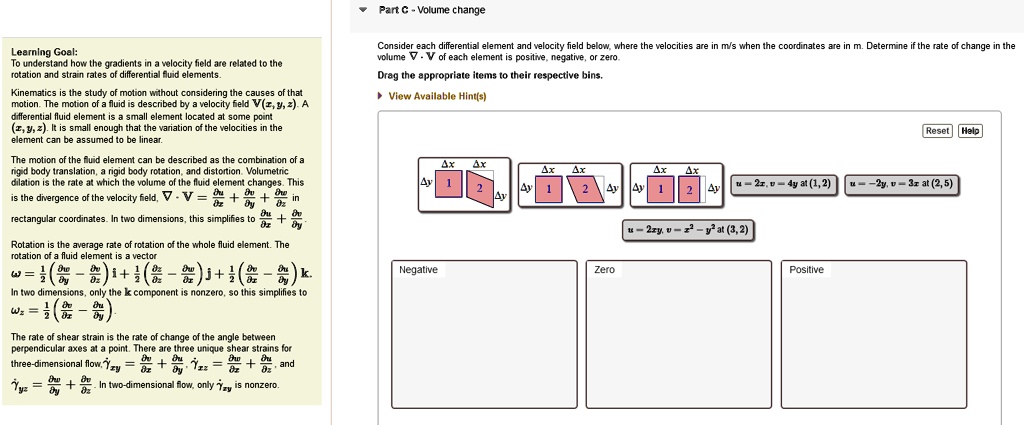
Consider each differential element and velocity field below, where the velocities are in (m)/(s) when the coordinates are in m. Determine if the rate of change in the
volume grad*V of each element is positive, negative, or zero.
Drag the appropriate items to their respective bins.
Part C-Volume change
Learning Goal To understand how the gradients in a velocity field are related to the rotation and strain rates of differential fluid elements. Kinematics is the study of motion without considering the causes of that motion. The motion of a fluid is described by a velocity field V(, y, z). A differential fluid element is a small element located at some point (, , z). It is small enough that the variation of the velocities in the element can be assumed to be linear.
Consider each diferential element and velocity field below, where the velocities are in m/s when the coordinates are in m. Determine if the rate of change in the volume V - V of each element is positive, negative, or zero. Drag the appropriate items to their respective bins.
View Available Hint(s)
Reset Help
The motion of the fluid element can be described as the combination of a rigid body translation, a rigid body rotation, and distortion. Volumetric dilation is the rate at which the volume of the fluid element changes. This is the dnvergence of the velocity field,V-V= te in
Ax
Ax
Ax
u=2x,v=4yat1,2
2y, u = 3 at (2, 5)
Oy
u=2xy.u=2-yat3,2
Rotation is the average rate of rotation of the whole fluid element. The rotation of a fluid element is a vector
Negative
Zero
Positive
Oy
The rate of shear strain is the rate of change of the angle between perpendicular axes at a point. There are three unique shear strains for ,and 8