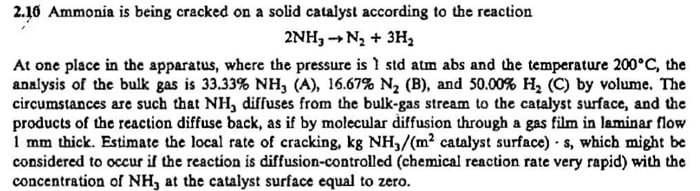
2.16 Ammonia is being cracked on a solid catalyst according to the reaction
\[
2 \mathrm{NH}_{3} \rightarrow \mathrm{~N}_{2}+3 \mathrm{H}_{2}
\]
At one place in the apparatus, where the pressure is 1 std atm abs and the temperature \( 200^{\circ} \mathrm{C} \), the analysis of the bulk gas is \( 33.33 \% \mathrm{NH}_{3}(\mathrm{~A}), 16.67 \% \mathrm{~N}_{2} \) (B), and \( 50.00 \% \mathrm{H}_{2} \) (C) by volume. The circumstances are such that \( \mathrm{NH}_{3} \) diffuses from the bulk-gas stream to the catalyst surface, and the products of the reaction diffuse back, as if by molecular diffusion through a gas film in laminar flow 1 mm thick. Estimate the local rate of cracking, \( \mathrm{kg} \mathrm{NH}_{3} /\left(\mathrm{m}^{2}\right. \) catalyst surface) \( \cdot \mathrm{s} \), which might be considered to occur if the reaction is diffusion-controlled (chemical reaction rate very rapid) with the concentration of \( \mathrm{NH}_{3} \) at the catalyst surface equal to zero.