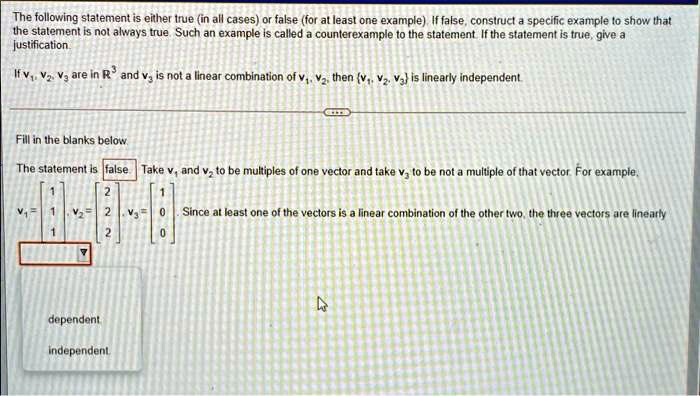
The following statement is either true (in all cases) or false (for at least one example). If false, construct a specific example to show that the statement is not always true. Such an example is called a counterexample to the statement. If the statement is true, give a justification.
If $v_1, v_2, v_3$ are in $R^3$ and $v_3$ is not a linear combination of $v_1, v_2$, then $(v_1, v_2, v_3)$ is linearly independent.
Fill in the blanks below.
The statement is false. Take $v_1$ and $v_2$ to be multiples of one vector and take $v_3$ to be not a multiple of that vector. For example,
$\begin{bmatrix} 1\\1\\1 \end{bmatrix} = v_1$, $\begin{bmatrix} 2\\2\\2 \end{bmatrix} = v_2$, $\begin{bmatrix} 1\\0\\0 \end{bmatrix} = v_3$. Since at least one of the vectors is a linear combination of the other two, the three vectors are linearly
dependent
independent