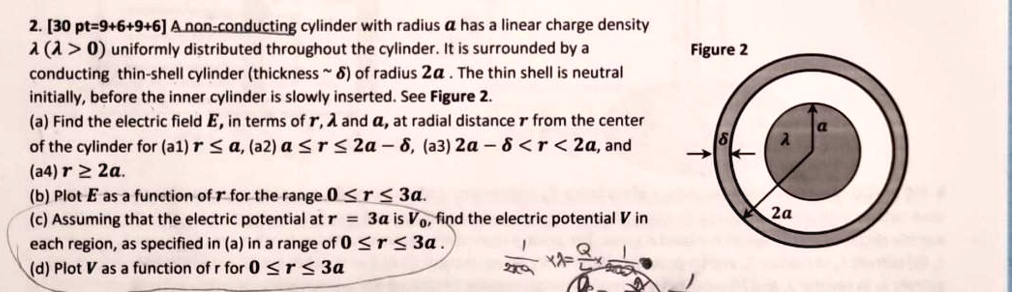
2. [30 pt=9+6+9+6] A non-conducting cylinder with radius $a$ has a linear charge density
$\lambda$ ($\lambda$ > 0) uniformly distributed throughout the cylinder. It is surrounded by a
conducting thin-shell cylinder (thickness $\sim \delta$) of radius $2a$. The thin shell is neutral
initially, before the inner cylinder is slowly inserted. See Figure 2.
Figure 2
(a) Find the electric field $E$, in terms of $r$, $\lambda$, and $a$, at radial distance $r$ from the center
of the cylinder for (a1) $r \le a$, (a2) $a \le r \le 2a - \delta$, (a3) $2a - \delta < r < 2a$, and
(a4) $r \ge 2a$.
(b) Plot $E$ as a function of $r$ for the range $0 \le r \le 3a$.
(c) Assuming that the electric potential at $r = 3a$ is $V_0$, find the electric potential $V$ in
each region, as specified in (a) in a range of $0 \le r \le 3a$.
(d) Plot $V$ as a function of $r$ for $0 \le r \le 3a$