Ace - AI Tutor
Ask Our Educators
Textbooks
My Library
Flashcards
Scribe - AI Notes
Notes & Exams
Download App
colleen iniesta

colleen i.

Divider

Questions asked

BEST MATCH

The spleen is essentially a giant lymph node, because it is encapsulated, has trabeculae, and filters lymph so n True or False True False

View Answer
divider
BEST MATCH

A market researcher is interested in the frequency with which customer visit suburban shopping center. In a sample of 180 shoppers, 126 say that they have visited the shopping center four or more times during the past month. Construct a 95% confidence interval for the population proportion. a. (0.633, 0.767) b. (0.133, 0.767) c. (0.633, 0.967) d. (0.3, 0.7)

View Answer
divider
BEST MATCH

What is name given to the regularly spaced infoldings of the sarcolemma? transverse or T tubules terminal cisternae sarcoplasmic reticulum motor endplates Hints

View Answer
divider
BEST MATCH

A bank loaned out $18,000, part of it at the rate of 7% per year and the rest at 17% per year. If the interest received in one year totaled $2500, how much was loaned at 7%?

View Answer
divider
BEST MATCH

An economy that trades goods and services with other countries is called: Question 68 options: a Marxist economy a blatant economy a risk economy an open economy

View Answer
divider
BEST MATCH

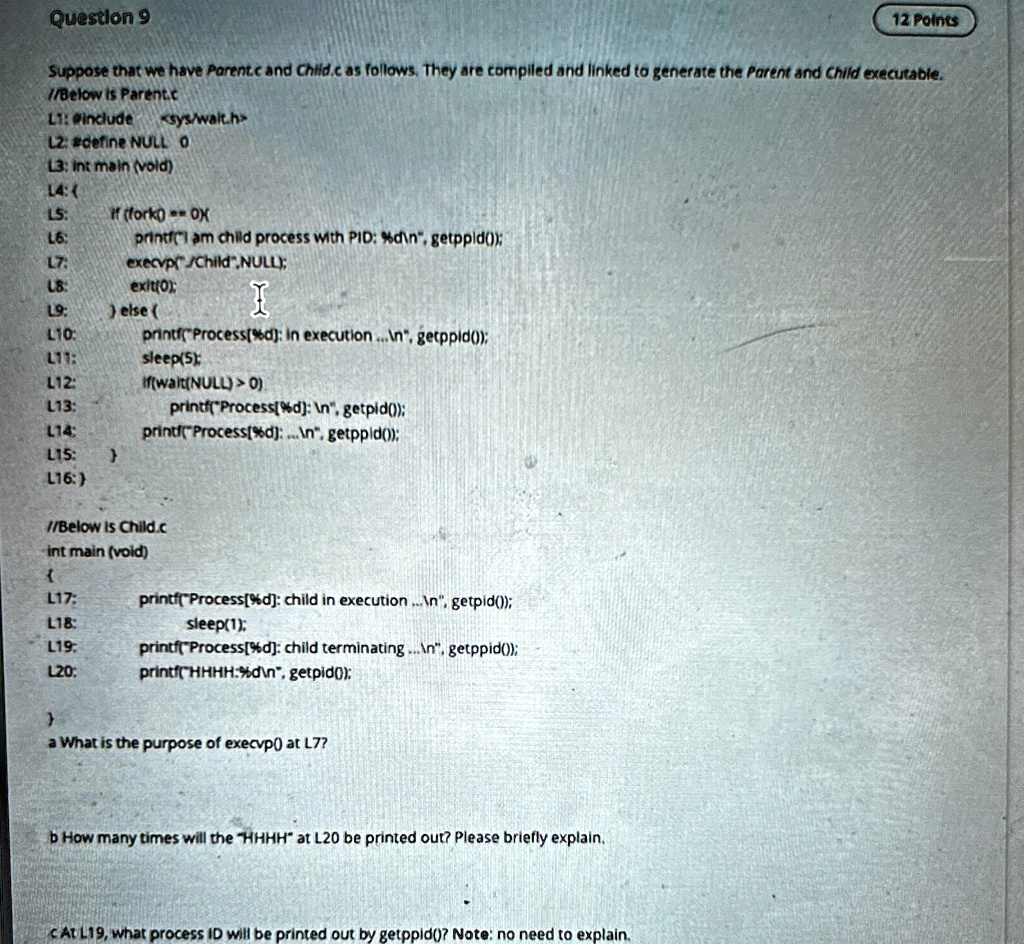
Question 9 Suppose that we have Parent.c and Child.c as follows. They are compiled and linked to generate the Parent and Child executable. Below is Parent.c: L1: #include <sys/wait.h> L2: #define NULL 0 L3: int main(void) L4: { L5: if(fork() == 0) L6: printf("I am child process with PID: %d ", getpid()); L7: execvp("Child", NULL); L8: exit(0); L9: } L10: else L11: { L12: sleep(5); L13: if(wait(NULL) > 0) L14: printf("Process[%d]: In", getpid()); L15: printf("Process(%d]: ... In", getpid()); L16: } Below is Child.c: int main(void) { printf("Process[%d]: child in execution ... ", getpid()); sleep(1); printf("Process[%d]: child terminating ... ", getppid()); printf("HHHH:%d ", getpid()); } a What is the purpose of execvp() at L7? b How many times will the "HHHH" at L20 be printed out? Please briefly explain. c At L19, what process ID will be printed out by getppid()? Note: no need to explain. Question 9 Suppose that we have Parent.c and Child.c as follows. They are compiled and linked to generate the Parent and Child executable. Below is Parent.c: L1: #include <sys/wait.h> L2: #define NULL 0 L3: int main(void) L4: { L5: if(fork() == 0) L6: printf("I am child process with PID: %d ", getpid()); L7: execvp("Child", NULL); L8: exit(0); L9: } L10: else L11: { L12: sleep(5); L13: if(wait(NULL) > 0) L14: printf("Process[%d]: ", getpid()); L15: printf("Process[%d] ", getpid()); L16: } Below is Child.c: int main(void) { printf("Process[%d]: child in execution ", getpid()); sleep(1); printf("Process[%d]: child terminating ", getppid()); printf("HHHH%d ", getpid()); } a What is the purpose of execvp() at L7? c At L19, what process ID will be printed out by getppid()? Note: no need to explain.
View Answer
divider
BEST MATCH

Amrinone (Inocor) is used for short-term therapy for CHF and acts by which of the following mechanisms? A. Increasing stroke volume and heart rate. B. Slowing ventricular rate and increasing cardiac output. C. Vasodilating and increasing peripheral vascular resistance. D. Increasing cardiac output and enhancing renal perfusion.

View Answer
divider
BEST MATCH

Find the derivative of the function $g(x) = \frac{e^{x^2}}{1 + \ln x}$ $\circ e^{x^2} \cdot \frac{2x(1 + \ln x) - 1}{x(1 + \ln x)^2}$ $\circ e^{x^2} \cdot \frac{2x^2 \ln x - 1}{x(1 + \ln x)^2}$ $\circ e^{x^2} \cdot \frac{2x^2(1 + \ln x) - 1}{x(1 + \ln x)^2}$ $\circ$ None of these

View Answer
divider
BEST MATCH

of 14.7 PSIA? $p = p_{y}gt$ A) 147,150 pa B) 150,000 pa C) 147,250 pa D) 147,000 pa 3- A spaceship leaves the space station with an acceleration of 15 ft/s². After 3 minutes the engines turn off and the acceleration is 0 ft/s². What is the average velocity of the spaceship? $x = x_o + v_ot + (0.5)at^2$ A) 81,100 ft/s B) 1,350 ft/s C) 243,000 ft/s D) 2,700 ft/s 4- An 18 wheeler has a mass of 28,000 kilograms when fully loaded. The truck goes from 0 to 90 kilometers per hour in 120 seconds. What is the force on the 18 wheeler due to acceleration? A) 1.08 kN B) 15.82 kN C) 10.71 kN D) 5.83 kN 5- The only point of inflection on the curve representing the equation $y = x^3 + x^2 - 3$ is at: A. $x = -2/3$ B. $x = -1/3$ C. $x = 0$

View Answer
divider
BEST MATCH

Strain refers to the deformation or change in shape that occurs in a material when subjected to external forces or loads. It is a measure of how much a material stretches or compresses under stress. Strain is typically expressed as a ratio or percentage of the change in length or shape of the material to its original length or shape. There are two main types of strain: normal strain and shear strain. Normal strain, also known as tensile or compressive strain, occurs when the forces act perpendicular to the surface of the material. This type of strain causes the material to either stretch (tensile strain) or compress (compressive strain). Shear strain, on the other hand, occurs when the forces act parallel to the surface of the material, causing it to deform by sliding or twisting. Strain can be calculated using the formula: Strain = (Change in length or shape) / (Original length or shape) This formula allows us to quantify the amount of deformation that has occurred in a material. The resulting value is dimensionless and is often expressed as a decimal or a percentage. It is important to note that strain is different from stress. While strain measures the deformation of a material, stress measures the internal forces or pressure that cause the deformation. The relationship between stress and strain is described by the material's mechanical properties, such as its Young's modulus or shear modulus. In summary, strain is the measure of deformation or change in shape that occurs in a material when subjected to external forces. It can be calculated using the change in length or shape divided by the original length or shape. Understanding strain is crucial in engineering and materials science, as it helps in predicting the behavior and performance of materials under different loading conditions.

View Answer
divider