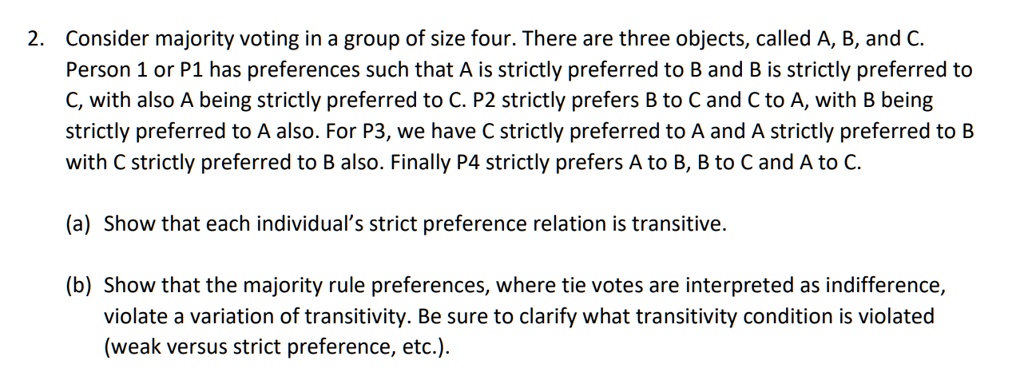
2. Consider majority voting in a group of size four. There are three objects, called A, B, and C.
Person 1 or P1 has preferences such that A is strictly preferred to B and B is strictly preferred to
C, with also A being strictly preferred to C. P2 strictly prefers B to C and C to A, with B being
strictly preferred to A also. For P3, we have C strictly preferred to A and A strictly preferred to B
with C strictly preferred to B also. Finally P4 strictly prefers A to B, B to C and A to C.
(a) Show that each individual's strict preference relation is transitive.
(b) Show that the majority rule preferences, where tie votes are interpreted as indifference,
violate a variation of transitivity. Be sure to clarify what transitivity condition is violated
(weak versus strict preference, etc.).