Ace - AI Tutor
Ask Our Educators
Textbooks
My Library
Flashcards
Scribe - AI Notes
Notes & Exams
Download App
lane d

lane d.

Divider

Questions asked

INSTANT ANSWER

We discussed in class how a system close to an energy minimum can be approximated by a harmonic oscillator (i.e. a spring) with potential energy 𝑈(𝑥) = 1 2⁄ 𝑚𝜔^2(𝑥 − 𝑥0) where 𝑥 is the position along the energy surface, 𝑥0 is the equilibrium position, 𝑚 is the mass of the system, 𝜔 is the angular frequency along 𝑥. Given that the total energy of the system is given as 𝐻(𝑥, 𝑝) = 𝑝^2/ 2𝑚+ 𝑈(𝑥) (where 𝑝 is the momentum along 𝑥) calculate the The partition function for the whole system (hint: your answer should be divided by Planck's constant to ensure correct units,

View Answer
divider
ANSWERED

Bcrypt_Sha256$$2B$12$We1Wwocamog01O5I.V2Tkouxdh4Ofnmgpwkor7Leaonfpu0Ubfpua Bcrypt_Sha256$$2B$12$We1Wwocamog01O5I.V2Tkokttmmj7Lscvwvlptp4Rlhbswcdg9.Wy verified

Numerade educator

How would I plot these following functions on mathematica where the x axis should be the probability between 0 and 1 of them occuring , and the x axis should be the log of Temperature. A) 4 / (4 + 11e^-(B*Eo) + 21e^-2(B*Eo)) B) 11e^-(B*Eo) / (4 + 11e^-(B*Eo) + 21e^-2(B*Eo)) C) 21e^-2(B*Eo) / (4 + 11e^-(B*Eo) + 21e^-2(B*Eo)) This is what they should roughly look like together: PLEASE PLOT ALL 3 ON SAME GRAPH Prob 1 0 Log T

View Answer
divider
ANSWERED

Aishwarya Krishnakumar verified

Numerade educator

H2O is a C2V point group, use a character table of the C2V point group to determine if the 1st and 2nd electronic transitions from the ground state is allowed or not.

View Answer
divider
ANSWERED

Timothy James verified

Numerade educator

The wave function for a free particle is ( Psi(x, t)=exp [i(k x-omega t)] ) (where ( mathrm{k} ) is the wave vector, ( x ) is the position, ( omega ) is the angular frequency and ( t ) is the time). For each of the following operators, determine if the wavefunction is an eigenfunction of that operator. If it is an eigenfunction, compute the eigenvalue and if not compute the expectation value. A. Position operator: ( hat{x}=x )

View Answer
divider
INSTANT ANSWER

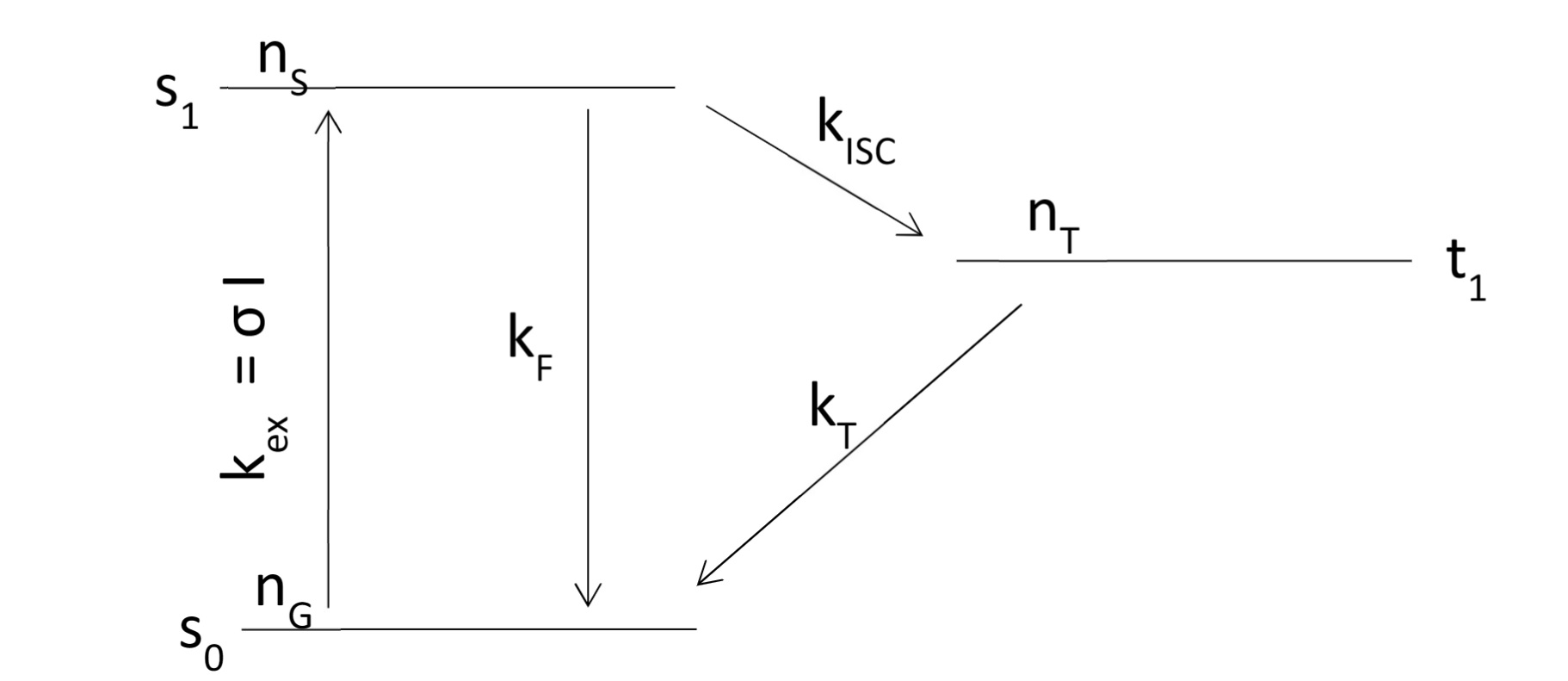
Given the 3 level photophysical-system with a singlet ground state, singlet excited state and triplet excited state and respective rate constants A determine the fluorescence emission rate, F, dependence on the other parameters in a single equation B. Using Mathematica, graph the fluorescence emission rate dependence on the excitation intensity, I (i.e., fluorescence emission rate, F, on the Y-axis and excitation intensity, I, on the X-axis) C. Determine the maximal fluorescence emission rate when the excitation intensity approaches infinity (i.e. F=? when I-->∞) D. Determine the saturation intensity, IS
View Answer
divider
INSTANT ANSWER

Please provide exact solutions, and a video if possible An unstructured, unfolded protein of 𝑁 amino acids in length are covalently modified such that residues 𝑖 and 𝑗 are attached (forming a loop). From this, estimate the change in chain entropy associated with this covalent modification. Assume the following: a) the unmodified protein's conformational space can be approximated as a sphere whose radius is equal to the root mean square distance of a 3D random walk of length 𝑁 b) the modified protein's conformational space can be approximated as two conjoined spheres: one whose radius is equal to the root mean square distance of a 3D random walk of length 𝑁 − (𝑗 − 𝑖) and one whose radius is equal to 𝑟loop. How would the entropy change if i and j were adjacent to each other as opposed to being at the very beginning and end of the sequence? What would you expect to be the size of rloop relative to (j-iℓ)^1/2 (where ℓ is the distance between adjacent amino acid alpha carbon)

View Answer
divider
INSTANT ANSWER

Please provide exact solutions, and a video if possible An unstructured, unfolded protein of 𝑁 amino acids in length are covalently modified such that residues 𝑖 and 𝑗 are attached (forming a loop). From this, estimate the change in chain entropy associated with this covalent modification. Assume the following: a) the unmodified protein's conformational space can be approximated as a sphere whose radius is equal to the root mean square distance of a 3D random walk of length 𝑁 b) the modified protein's conformational space can be approximated as two conjoined spheres: one whose radius is equal to the root mean square distance of a 3D random walk of length 𝑁 − (𝑗 − 𝑖) and one whose radius is equal to 𝑟loop. How would the entropy change if i and j were adjacent to each other as opposed to being at the very beginning and end of the sequence? What would you expect to be the size of rloop relative to (j-iℓ)^1/2 (where ℓ is the distance between adjacent amino acid alpha carbon)

View Answer
divider
INSTANT ANSWER

Please provide exact solutions, and a video if possible An unstructured, unfolded protein of 𝑁 amino acids in length are covalently modified such that residues 𝑖 and 𝑗 are attached (forming a loop). From this, estimate the change in chain entropy associated with this covalent modification. Assume the following: a) the unmodified protein's conformational space can be approximated as a sphere whose radius is equal to the root mean square distance of a 3D random walk of length 𝑁 b) the modified protein's conformational space can be approximated as two conjoined spheres: one whose radius is equal to the root mean square distance of a 3D random walk of length 𝑁 − (𝑗 − 𝑖) and one whose radius is equal to 𝑟loop. How would the entropy change if i and j were adjacent to each other as opposed to being at the very beginning and end of the sequence? What would you expect to be the size of rloop relative to (j-iℓ)^1/2 (where ℓ is the distance between adjacent amino acid alpha carbon)

View Answer
divider
AWAITING AN EDUCATOR

Please provide clear steps and an exact answer Given that the time independent wave function for the particle in a one-dimensional box is: \[ \psi(x)=\sqrt{\frac{2}{L}} \cdot \sin \left(\frac{n \pi x}{L}\right) \] a. Determine if this wave function is an eigenfunction of the momentum operator. What is the expectation value of this operator? \[ \frac{h}{i} \cdot \frac{\partial}{\partial x} \] b. Determine if this wave function is an eigenfunction of the momentum operator squared. What isthe expectation value of this operator? \[ \left(\frac{h}{i} \cdot \frac{\partial}{\partial x}\right)^{2}=-h b a r^{2} \cdot \frac{\partial^{2}}{\partial x^{2}} \] c. Could you measure both quantities at the same time (i.e., measure one without upsetting the other)?

View Answer
divider
AWAITING AN EDUCATOR

\( \int_{-\infty}^{\infty} \mathrm{e}^{-a \cdot(x-b)^{2}} \mathrm{~d} x=\sqrt{\frac{\pi}{a}} \)

View Answer
divider