Ace - AI Tutor
Ask Our Educators
Textbooks
My Library
Flashcards
Scribe - AI Notes
Notes & Exams
Download App
concepci-n zaragoza

concepci-n z.

Divider

Questions asked

BEST MATCH

For Problems 1-3, solve the system by either the substitution or elimination method. Show the check. 1. $3x - y = -5$ $2x + 3y = 4$ 2. $y = 3x + 2$ $2x - 3y = 11.5$ 3. $-6x + 3y = 21$ $12x - 4y = 8$

View Answer
divider
BEST MATCH

Which virus is responsible for causing infectious mononucleosis in clients? Parvovirus Coronavirus Rotavirus Epstein-Barr virus

View Answer
divider
BEST MATCH

(30) Consider a 1 x 1m flat, square horizontal plate embedded in an insulating material and exposed to air at 10 °C as shown in the figure. The plate is electrically heated to maintain its exposed surface at 100 °C. The bottom surface and the edges of the plate are insulated, while the upper surface is also exposed to Solar irradiation of 500W/m². The "Reflectivity p" of this opaque plate is given in the following figure. The radiation temperature of the environment is also $T_{rad-env}$ = 10°C a. What is the absorption rate of the solar radiation on the plate? W/m² b. What is the net **radiative** heat exchange rate between the plate and the environment? c. For quiescent/still air conditions, find the $h_{conv}$ and estimate the power required $P_{elec}$ in Watts to maintain the surface temperature at 100 °C. d. Now, consider **turbulent** wind blowing over the surface with a free stream air velocity of 10.0 m/s blowing "from one of the sides (figure). Find the $h_{conv}$ and calculate the "Power" required to maintain the same temperature of 100°C over the surface. Hint: Look at your HW#3 Pr.#5 Air 5,800K Part-b: Air Flow, U = 10 m/s 500W/m² $T_∞$ = 10°C $T_s$ = 100°C 555 555 Part - a: Natural Convection Im Insulation Insulation Reflectivity 0.8 $P_λ$ $P_{λ,2}$ Power supply $P_{λ,1}$ 0.2 0 1 μm λ,μ For air: $V_{air}$ = 20.0 x 10⁻⁶ m²/s; $a_{air}$ = 40.0 x 10⁻⁶ m²/s; Pr = 0.7; $k_{air}$ = 0.0263 W/mK; β = 0.0025 K-1 gB(Ts-Too) L Vel. L Radiation: σ = 5.67 x 10⁻⁸ W/m² K4 $Ra_L$ = αν : $Re_L$ = Characteristic $L_c$ = Area/Perimeter; Note: $ε_λ$ = $α_λ$

View Answer
divider
BEST MATCH

Add the values required for the Thevenin equivalent circuit of the Wheatstone bridge to Figure 2 , assuming no vibration so only the steady state deformation of the cantilever applies. The Thevenin resistance is 120Omega Thevenin voltage = mV Add the values required for the Thevenin equivalent circuit of the Wheatstone bridge to Figure 2, assuming no vibration so only the steady state deformation of the cantilever applies Thevenin resistance= 120 0 output V Thevenin voltage= Number mV

View Answer
divider
BEST MATCH

If you have become habituated to the neighbor playing drums, you are likely to become dishabituated if: Question 38 options: the noise of the drums becomes softer you are sleeping the neighbor continues to play through the night somebody unexpectedly rings your doorbell

View Answer
divider
BEST MATCH

2. Name this compound properly.

View Answer
divider
BEST MATCH

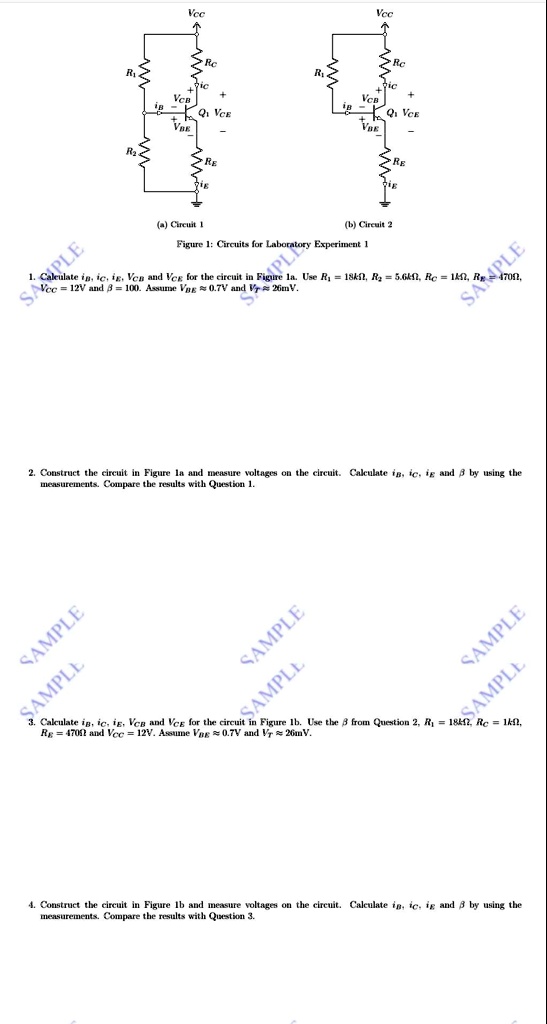
Vcc Vcc R R R? Vo Q? VCE VCE VBE VBE R RE RE PLE (a) Circuit 1 (b) Circuit 2 Figure 1: Circuits for Laboratory Experiment 1 1. Calculate $i_B$, $i_C$, $i_E$, $V_{CB}$ and $V_{CE}$ for the circuit in Figure 1a. Use $R_1 = 18k\Omega$, $R_2 = 5.6k\Omega$, $R_C = 14\Omega$, $R_E = 470\Omega$, $V_{CC} = 12V$ and $\beta = 100$. Assume $V_{BE} \approx 0.7V$ and $V_T \approx 26mV$. SAMPLE 2. Construct the circuit in Figure 1a and measure voltages on the circuit. Calculate $i_B$, $i_C$, $i_E$ and $\beta$ by using the measurements. Compare the results with Question 1. SAMPLE SAMPLE SAMPLE SAMPLE SAMPLE 3. Calculate $i_B$, $i_C$, $i_E$, $V_{CB}$ and $V_{CE}$ for the circuit in Figure 1b. Use the $\beta$ from Question 2, $R_1 = 18k\Omega$, $R_C = 14\Omega$, $R_E = 470\Omega$ and $V_{CC} = 12V$. Assume $V_{BE} \approx 0.7V$ and $V_T \approx 26mV$. 4. Construct the circuit in Figure 1b and measure voltages on the circuit. Calculate $i_B$, $i_C$, $i_E$ and $\beta$ by using the measurements. Compare the results with Question 3.
View Answer
divider
BEST MATCH

8. Study the following code. Explain what this code does in general and each block of the code. You don't need to explain the algorithm used. (15points) #define ARSIZE 10 int ch_arr[ARSIZE], count1; int count2, stop, lastchar; lastchar= 0; stop = 0; while(stop != 1) { ch_arr[lastchar] = getchar(); if (ch_arr[lastchar] == '\n') stop = 1; else lastchar = lastchar + 1; if(lastchar == ARSIZE) stop = 1; } lastchar = lastchar-1; count1 = 0; while (count1 < lastchar) { count2 = count1 + 1; while (count2 <= lastchar) { if (ch_arr[count1] > ch_arr[count2]) { int temp; temp = ch_arr[count1]; ch_arr[count1] = ch_arr[count2]; ch_arr[count2] = temp; } count2 = count2 + 1; } count1 = count1 + 1; } count1 = 0; while(count1 <= lastchar){ printf("%c\n", ch_arr[count1]); count1 = count1 + 1; }

View Answer
divider
BEST MATCH

The merger of two companies that make products required at different stages of the production cycle is called ________. economies of scale horizontal integration economies of scope vertical integration

View Answer
divider
BEST MATCH

36. A country has national saving of $70 billion, government expenditures of $20 billion, domestic investment of $30 billion, and net capital outflow of $40 billion. What is its supply of loanable funds? . a.$30 billion b.$40 billion c.$50 billion d.$70 billion

View Answer
divider