Ace - AI Tutor
Ask Our Educators
Textbooks
My Library
Flashcards
Scribe - AI Notes
Notes & Exams
Download App
Connie Antoniou

Connie A.

Divider

Questions asked

INSTANT ANSWER

2.) Let \( f \) be the function given by: \( f(x)=\sin \left(x^{2}\right)+\cos (x) \). The graph of \( f^{(5)}(x) \) is shown above. a) Write the first four nonzero terms of the Taylor series for \( \sin (x) \) about \( x=0 \) and write the first four nonzero terms of the Taylor series for \( \sin \left(x^{2}\right) \) about \( x=0 \). c) Find the value of \( f^{(5)}(0) \). d) Let \( P(x) \) be the fourth-degree Taylor polynomial for \( f \) about \( x=0 \). Using information from the given graph, show that \( \left\lvert\, P_{4}\left(\frac{1}{4}\right)-f\left(\frac{1}{4}\right)<\frac{1}{3000}\right. \). b) Write the first four nonzero terms of the Taylor series for \( \cos (x) \) about \( x=0 \). Use this series and the series for \( \sin \left(x^{2}\right) \) you found in part a to write the first four nonzero terms of the Taylor series about \( x= \) 0 for \( f \).

View Answer
divider
ANSWERED

Ivan Kochetkov verified

Numerade educator

1. Write an expression for the nth term of the sequence 4, -4, 8/3, -4/3, ... (A) (-1)^(n+1) 2^(n+1) / (n+1)! (B) (-1)^(n+1) 2^(n+1) / n! (C) (-1)^n 2^n / n! (D) (-1)^n 2^n / (n-1)! (E) None of these

View Answer
divider
ANSWERED

Sam Stansfield verified

Numerade educator

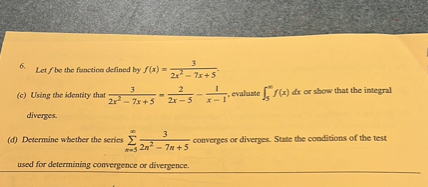
6. Let f be the function defined by f(x) = 3 / (2x^2 - 7x + 5). (c) Using the identity that 3 / (2x^2 - 7x + 5) = 2 / (2x - 5) - 1 / (x - 1), evaluate ?_5^? f(x) dx or show that the integral diverges. (d) Determine whether the series ?_{n=5}^? 3 / (2n^2 - 7n + 5) converges or diverges. State the conditions of the test used for determining convergence or divergence.
View Answer
divider
ANSWERED

Vincenzo Zaccaro verified

Numerade educator

6. Let f be the function defined by f(x) = 3 / (2x^2 - 7x + 5). (c) Using the identity that 3 / (2x^2 - 7x + 5) = 2 / (2x - 5) - 1 / (x - 1), evaluate ?[5,?] f(x) dx or show that the integral diverges. (d) Determine whether the series ?[n=5,?] 3 / (2n^2 - 7n + 5) converges or diverges. State the conditions of the test used for determining convergence or divergence.

View Answer
divider
ANSWERED

Yujie Wang verified

Numerade educator

Let f be the function defined by f(x) = 3 / (2x^2 - 7x + 5). (a) Find the slope of the line tangent to the graph of f at x = 3. (b) Find the x-coordinate of each critical point of f in the interval 1 < x < 2.5. Classify each critical point as the location of a relative minimum, a relative maximum, or neither. Justify your answers.

View Answer
divider
ANSWERED

Sam Stansfield verified

Numerade educator

5. sum_{i=0}^{n} (frac{1}{3})^i = A. frac{3}{2} - (frac{1}{3})^n B. frac{3}{2} [1 - (frac{1}{3})^n] C. frac{3}{2} (frac{1}{3})^n D. frac{2}{3} (frac{1}{3})^n E. frac{2}{3} (frac{1}{3})^{n-1}

View Answer
divider
ANSWERED

Zack A verified

Numerade educator

5. sum_{j=1}^{n} (frac{1}{3})^{j} = A. frac{3}{2} - (frac{1}{3})^{n} B. frac{3}{2} [1 - (frac{1}{3})^{n}] C. frac{3}{2} (frac{1}{3})^{n} D. frac{2}{3} (frac{1}{3})^{n} E. frac{2}{3} (frac{1}{3})^{n+1}

View Answer
divider
ANSWERED

Zhumagali Shomanov verified

Numerade educator

5. sum_{i=n}^{infty}left(frac{1}{3} ight)^{i} = A. frac{3}{2} - left(frac{1}{3} ight)^{n} B. frac{3}{2} left[ 1 - left(frac{1}{3} ight)^{n} ight] C. frac{3}{2} left(frac{1}{3} ight)^{n} D. frac{2}{3} left(frac{1}{3} ight)^{n} E. frac{2}{3} left(frac{1}{3} ight)^{n+1}

View Answer
divider
ANSWERED

Sam Stansfield verified

Numerade educator

3. Which of the following converges ABSOLUTELY? (A) sum_{n=1}^{infty} frac{(-1)^{n+1}}{sqrt[3]{n+1}} (B) sum_{n=1}^{infty} frac{(-1)^{n+1}}{n+1} (C) sum_{n=1}^{infty} frac{(-1)^{n+1}}{ln(n+1)} (D) sum_{n=1}^{infty} frac{(-1)^{n+1}}{sqrt{n+1}} (E) sum_{n=1}^{infty} frac{(-1)^{n+1}}{(n+1)^2}

View Answer
divider
ANSWERED

Luke Humphrey verified

Numerade educator

5.) Consider the Maclaurin Polynomial with derivatives of all orders that converges for all values of x on its Interval of Convergence: f(x) = x - x^2/2 + x^3/3 - x^4/4 + ... a) Write a summation formula for the n^th term of the polynomial. b) Determine the Interval of Convergence for the Power Series represented by the function f(x). Show the work that leads to your answer. c) Write a summation formula for the nth term of the f(cos(x)). d) Consider the series that results from f(1). Does the resulting series converge absolutely, conditionally, or diverge? Explain your reasoning.

View Answer
divider