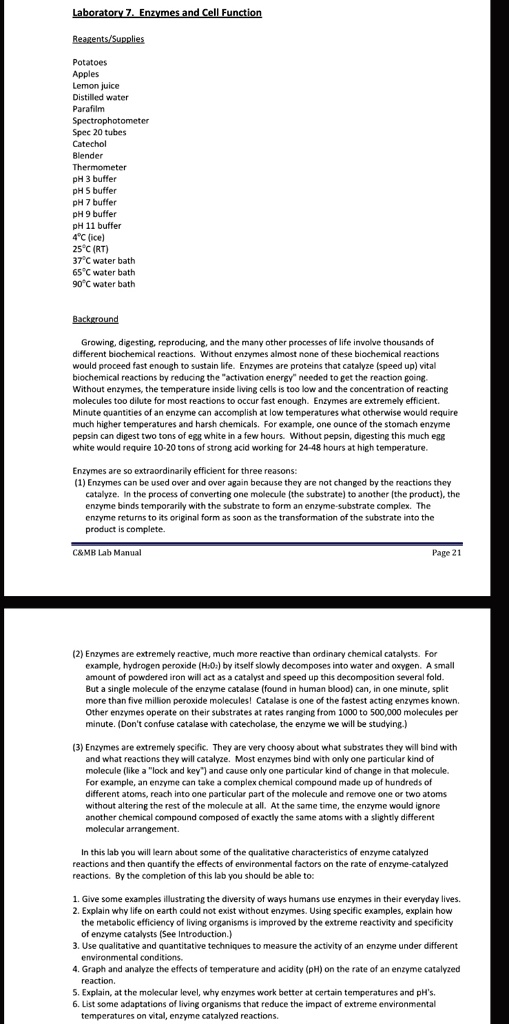
PLEASE HELP ME WRITE AN HYPOTHESIS AND OBJECTIVE FOR THIS LAB Laboratory 7. Enzymes and Cell Function
Reagents/Supplies
Potatoes
Apples
Lemon juice
Distilled water
Parafilm
Spectrophotometer
Spec 20 tubes
Catechol
Blender
Thermometer
pH 3 buffer
pH 5 buffer
pH7 buffer
pH 9 buffer
pH11 buffer
4deg C (ice)
25deg C (RT)
37deg C water bath
65deg C water bath
90deg C water bath
Background
Growing, digesting, reproducing, and the many other processes of life involve thousands of different biochemical reactions. Without enzymes almost none of these biochemical reactions would proceed fast enough to sustain life. Enzymes are proteins that catalyze (speed up) vital biochemical reactions by reducing the "activation energy" needed to get the reaction going. Without enzymes, the temperature inside living cells is too low and the concentration of reacting molecules too dilute for most reactions to occur fast enough. Enzymes are extremely efficient. Minute quantities of an enzyme can accomplish at low temperatures what otherwise would require much higher temperatures and harsh chemicals. For example, one ounce of the stomach enzyme pepsin can digest two tons of egg white in a few hours. Without pepsin, digesting this much egg white would require 10-20 tons of strong acid working for 24-48 hours at high temperature.
Enzymes are so extraordinarily efficient for three reasons:
(1) Enzymes can be used over and over again because they are not changed by the reactions they catalyze. In the process of converting one molecule (the substrate) to another (the product), the enzyme binds temporarily with the substrate to form an enzyme-substrate complex. The enzyme returns to its original form as soon as the transformation of the substrate into the product is complete.
C&MB Lab Manual
Page 21
(2) Enzymes are extremely reactive, much more reactive than ordinary chemical catalysts. For example, hydrogen peroxide (H_(2)O_(2)) by itself slowly decomposes into water and oxygen. A small amount of powdered iron will act as a catalyst and speed up this decomposition several fold. But a single molecule of the enzyme catalase (found in human blood) can, in one minute, split more than five million peroxide molecules! Catalase is one of the fastest acting enzymes known. Other enzymes operate on their substrates at rates ranging from 1000 to 500,000 molecules per minute. (Don't confuse catalase with catecholase, the enzyme we will be studying.)
(3) Enzymes are extremely specific. They are very choosy about what substrates they will bind with and what reactions they will catalyze. Most enzymes bind with only one particular kind of molecule (like a "lock and key") and cause only one particular kind of change in that molecule. For example, an enzyme can take a complex chemical compound made up of hundreds of different atoms, reach into one particular part of the molecule and remove one or two atoms without altering the rest of the molecule at all. At the same time, the enzyme would ignore another chemical compound composed of exactly the same atoms with a slightly different molecular arrangement.
In this lab you will learn about some of the qualitative characteristics of enzyme catalyzed reactions and then quantify the effects of environmental factors on the rate of enzyme-catalyzed reactions. By the completion of this lab you should be able to:
Give some examples illustrating the diversity of ways humans use enzymes in their everyday lives.
Explain why life on earth could not exist without enzymes. Using specific examples, explain how the metabolic efficiency of living organisms is improved by the extreme reactivity and specificity of enzyme catalysts (See Introduction.)
Use qualitative and quantitative techniques to measure the activity of an enzyme under different environmental conditions.
Graph and analyze the effects of temperature and acidity (pH) on the rate of an enzyme catalyzed reaction.
Explain, at the molecular level, why enzymes work better at certain temperatures and pH's.
List some adaptations of living organisms that reduce the impact of extreme environmental temperatures on vital, enzyme catalyzed reactions.
Laboratory 7. Enzymes and Cell Function
Reagents/Supplies
Potatoes Apples Lemon juice Distilled water Parafilm Spectrophotometer Spec 20 tubes Catechol Blender Thermometer pH 3 buffer pH 5 buffer pH 7 buffer pH 9 buffer pH 11 buffer 4C (ice) 25C (RT) 37C water bath 65C water bath 90C water bath
Background
Growing, digesting, reproducing, and the many other processes of life involve thousands of different biochemical reactions. Without enzymes almost none of these biochemical reactions would proceed fast enough to sustain life.Enzymes are proteins that catalyze (speed up) vital
Without enzymes, the temperature inside living cells is too low and the concentration of reacting molecules too dilute for most reactions to occur fast enough. Enzymes are extremely efficient. Minute quantities of an enzyme can accomplish at low temperatures what otherwise would require much higher temperatures and harsh chemicals. For example, one ounce of the stomach enzyme pepsin can digest two tons of egg white in a few hours. Without pepsin, digesting this much egg white would require 10-20 tons of strong acid working for 24-48 hours at high temperature.
Enzymes are so extraordinarily efficient for three reasons: (1) Enzymes can be used over and over again because they are not changed by the reactions they catalyze. In the process of converting one molecule (the substrate) to another (the product), the enzyme binds temporarily with the substrate to form an enzyme-substrate complex. The enzyme returns to its original form as soon as the transformation of the substrate into the product is complete.
C&MB Lab Manual
Page 21
(2) Enzymes are extremely reactive, much more reactive than ordinary chemical catalysts. For example, hydrogen peroxide (H:0:) by itself slowly decomposes into water and oxygen. A small amount of powdered iron will act as a catalyst and speed up this decomposition several fold. But a single molecule of the enzyme catalase (found in human blood) can, in one minute, split more than five million peroxide molecules! Catalase is one of the fastest acting enzymes known. Other enzymes operate on their substrates at rates ranging from 1000 to 500,000 molecules per minute. (Don't confuse catalase with catecholase, the enzyme we will be studying.)
(3 Enzymes are extremely specific. They are very choosy about what substrates they will bind with and what reactions they will catalyze. Most enzymes bind with only one particular kind of molecule (like a lock and key*) and cause only one particular kind of change in that molecule. For example, an enzyme can take a complex chemical compound made up of hundreds of different atoms, reach into one particular part of the molecule and remove one or two atoms without altering the rest of the molecule at all. At the same time, the enzyme would ignore another chemical compound composed of exactly the same atoms with a slightly different
In this lab you willearn about some of the qualitative characteristics of enzyme catalyzed reactions and then quantify the effects of environmental factors on the rate of enzyme-catalyzed reactions. By the completion of this lab you should be able to:
1. Give some examples illustrating the diversity of ways humans use enzymes in their everyday lives. 2. Explain why life on earth could not exist without enzymes. Using specific examples, explain how the metabolic efficiency of living organisms is improved by the extreme reactivity and specificity of enzyme catalysts (See Introduction.) 3. Use qualitative and quantitative techniques to measure the activity of an enzyme under different environmental conditions. 4. Graph and analyze the effects of temperature and acidity (pH) on the rate of an enzyme catalyzed reaction. 5. Explain, at the molecular level, why enzymes work better at certain temperatures and pH's. 6. List some adaptations of living organisms that reduce the impact of extreme environmental temperatures on vital, enzyme catalyzed reactions.