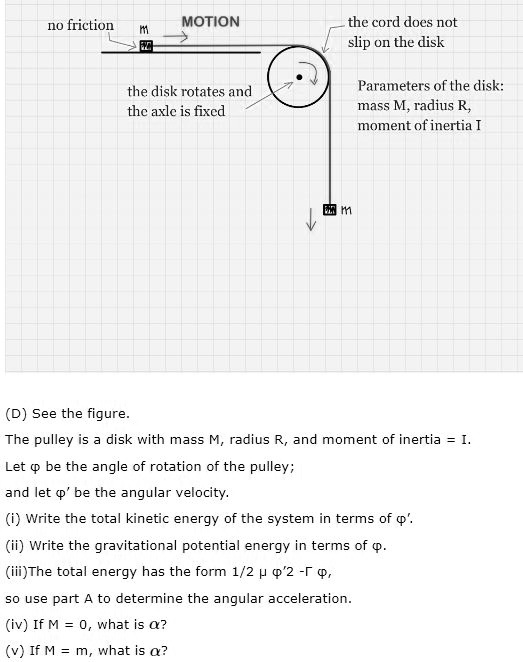
no friction
MOTION
M
the disk rotates and
the axle is fixed
the cord does not
slip on the disk
Parameters of the disk:
mass M, radius R,
moment of inertia I
m
(D) See the figure.
The pulley is a disk with mass M, radius R, and moment of inertia = I.
Let $\phi$ be the angle of rotation of the pulley;
and let $\phi'$ be the angular velocity.
(i) Write the total kinetic energy of the system in terms of $\phi'$.
(ii) Write the gravitational potential energy in terms of $\phi$.
(iii) The total energy has the form $1/2 \mu \phi'^2 - \Gamma \phi$,
so use part A to determine the angular acceleration.
(iv) If M = 0, what is $\alpha$?
(v) If M = m, what is $\alpha$?