Ace - AI Tutor
Ask Our Educators
Textbooks
My Library
Flashcards
Scribe - AI Notes
Notes & Exams
Download App
connor peir-

connor p.

Divider

Questions asked

BEST MATCH

How much of a change in the membrane potential is necessary for the summation of postsynaptic potentials to result in an action potential being generated? Group of answer choices +10 mV -15 mV +15 mV +30 mV

View Answer
divider
BEST MATCH

2. Consider the following loop where $n = 2^k$ for $k \ge 0$: sum $\leftarrow$ 0; for i $\leftarrow$ 0 to k do for j $\leftarrow$ $2^i$ to n do sum $\leftarrow$ sum + 1 (a) Count the number of times that sum $\leftarrow$ sum + 1 is executed. (b) What is the efficiency class of the loop?

View Answer
divider
BEST MATCH

If f(x) = ∫₀^(x^3) cos(t^2) dt, then f'(√(π)) = (A) 3π sin(π^3) (B) cos(π^3) (C) 3π cos(π) (D) 3π cos(π^3)

View Answer
divider
BEST MATCH

What is the concentration of lithium ions in 0.370 M $Li_2HPO_4$?

View Answer
divider
BEST MATCH

Check Understanding A faucet leaks (5)/(8) quart of water in 15 minutes. How many quarts does the faucet leak per hour? Toni ran (4)/(5) mile in (1)/(5) hour. Write an equation for the distance in miles y that she ran in x hours if she ran at a constant rate. Write (3)/(4) cup per (1)/(2) serving as a unit rate. Write 2(1)/(4) miles in (3)/(4) hour as a unit rate.

View Answer
divider
BEST MATCH

water sugar A B -Q2: How much water will move? Show the math 100ml 4% 100 ml 8% -Q3: after water movement, what will be the final volume in A? in B? Volume in A: 100 ml Concentration In A: 4% (4 red dots in 100 ml water) Volume in B: 100 ml Concentration in B: 8% (8 red dots in 100 ml water) -Q4: after water movement, what will be the final concentration in A? B? Show the math. -Q5: Are the final concentrations equal? Why?

View Answer
divider
BEST MATCH

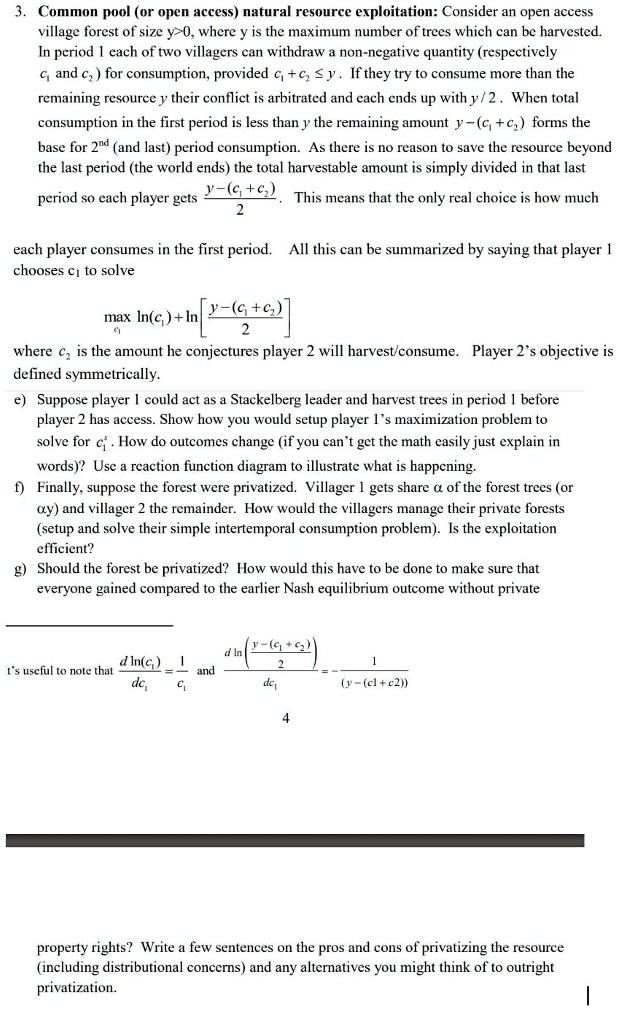
Nash Equilibrium - Resource Exploitation 3.Common pool(or open access natural resource exploitation:Consider an open access village forest of size y>0, where y is the maximum number of trees which can be harvested. In period 1 each of two villagers can withdraw a non-negative quantity (respectively c and c,for consumption,provided c+c, y. If they try to consume more than the remaining resource y their conflict is arbitrated and each ends up with y/2. When total consumption in the first period is less than y the remaining amount y-c+c,) forms the base for 2n(and last) period consumption. As there is no reason to save the resource beyonc the last period (the world ends) the total harvestable amount is simply divided in that last This means that the only real choice is how much 2 each player consumes in the first period.All this can be summarized by saying that player 1 chooses c1 to solve 2 where c, is the amount he conjectures player 2 will harvest/consume.Player 2's objective is defined symmetrically. e Suppose player I could act as a Stackelberg leader and harvest trees in period 1 before player 2 has access. Show how you would setup player 1's maximization problem to solve for c. How do outcomes change (if you can't get the math easily just explain in words)? Use a reaction function diagram to illustrate what is happening f) Finally, suppose the forest were privatized. Villager 1 gets share of the forest trees (or y and villager 2 the remainder. How would the villagers manage their private forests (setup and solve their simple intertemporal consumption problem.Is the exploitation efficient? g) Should the forest be privatized? How would this have to be done to make sure that everyone gained compared to the earlier Nash equilibrium outcome without private d In y-c+c dIn(c,) 1 2 t's useful to note that and dc, dey 1 y=cl+c2 4 property rights? Write a few sentences on the pros and cons of privatizing the resource including distributional concerns and any alternatives you might think of to outright privatization.
View Answer
divider
BEST MATCH

Entrepreneurial innovation can * 1 poin best be defined as ....? A. The successful exploitation of new ideas B. The evolution of new ideas C. The opposite of creativity D. The generation of new ideas

View Answer
divider
BEST MATCH

Provide the total Capacitive Reactance for the following circuit and show your work by uploading your solution to Canvas Voltage Source is 120V @ 60Hz* C1 = 100 µF C2 = 220 µF C3 = 470 µF

View Answer
divider
BEST MATCH

Figure 4.3 Textiles Nation 1's ppf Nation 2's ppf Computers

View Answer
divider