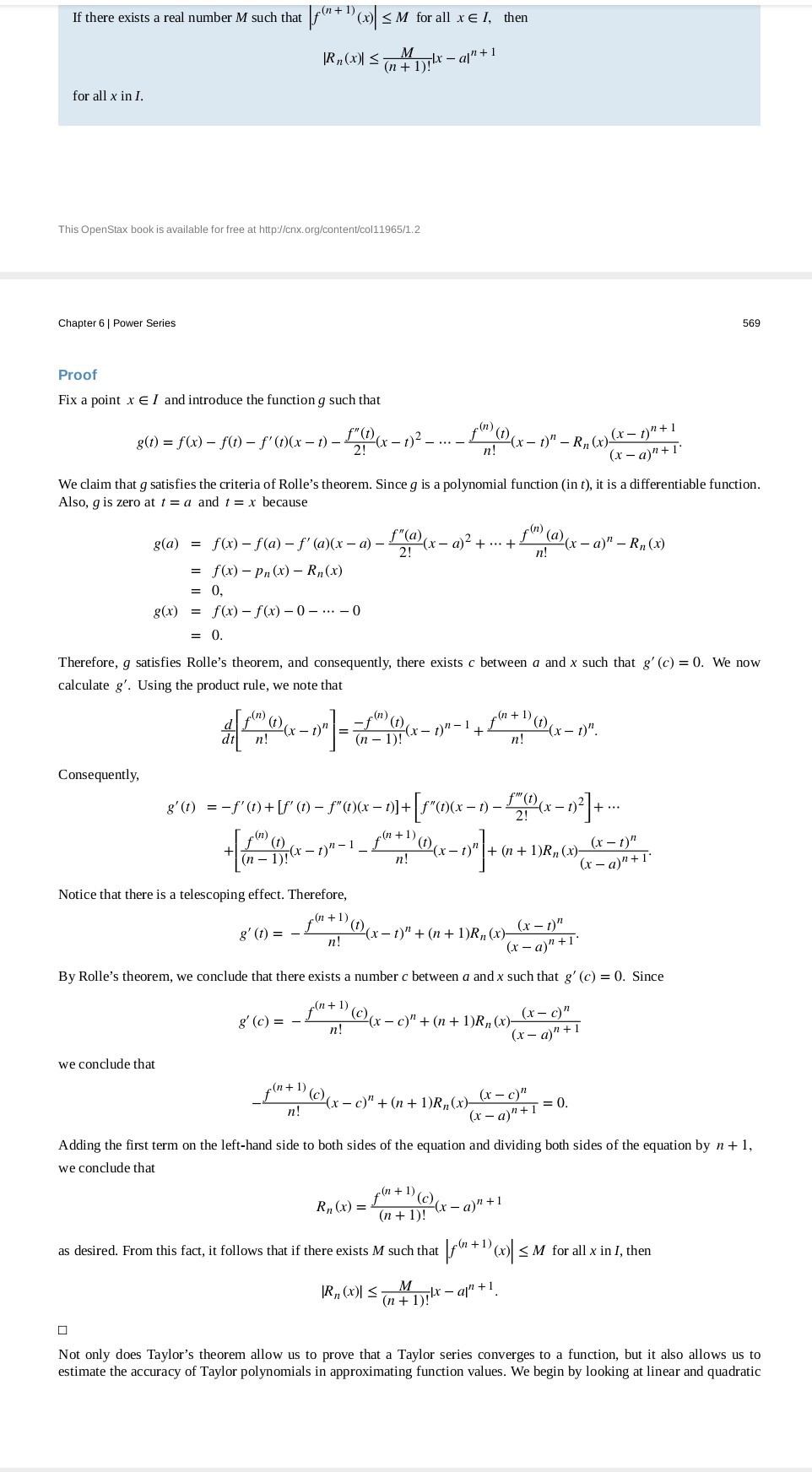
If there exists a real number \( M \) such that \( \left|f^{(n+1)}(x)\right| \leq M \) for all \( x \in I \), then
\[
\left|R_{n}(x)\right| \leq \frac{M}{(n+1)!}|x-a|^{n+1}
\]
for all \( x \) in \( I \).
This OpenStax book is available for free at http://cnx.org/content/col11965/1.2
Chapter \( 6 \mid \) Power Series
569
Proof
Fix a point \( x \in I \) and introduce the function \( g \) such that
\[
g(t)=f(x)-f(t)-f^{\prime}(t)(x-t)-\frac{f^{\prime \prime}(t)}{2!}(x-t)^{2}-\cdots-\frac{f^{(n)}(t)}{n!}(x-t)^{n}-R_{n}(x) \frac{(x-t)^{n+1}}{(x-a)^{n+1}} .
\]
We claim that \( g \) satisfies the criteria of Rolle's theorem. Since \( g \) is a polynomial function (in \( t \) ), it is a differentiable function. Also, \( g \) is zero at \( t=a \) and \( t=x \) because
\[
\begin{aligned}
g(a) & =f(x)-f(a)-f^{\prime}(a)(x-a)-\frac{f^{\prime \prime}(a)}{2!}(x-a)^{2}+\cdots+\frac{f^{(n)}(a)}{n!}(x-a)^{n}-R_{n}(x) \\
& =f(x)-p_{n}(x)-R_{n}(x) \\
& =0, \\
g(x) & =f(x)-f(x)-0-\cdots-0 \\
& =0 .
\end{aligned}
\]
Therefore, \( g \) satisfies Rolle's theorem, and consequently, there exists \( c \) between \( a \) and \( x \) such that \( g^{\prime}(c)=0 \). We now calculate \( g^{\prime} \). Using the product rule, we note that
\[
\frac{d}{d t}\left[\frac{f^{(n)}(t)}{n!}(x-t)^{n}\right]=\frac{-f^{(n)}(t)}{(n-1)!}(x-t)^{n-1}+\frac{f^{(n+1)}(t)}{n!}(x-t)^{n} .
\]
Consequently,
\[
\begin{aligned}
g^{\prime}(t)= & -f^{\prime}(t)+\left[f^{\prime}(t)-f^{\prime \prime}(t)(x-t)\right]+\left[f^{\prime \prime}(t)(x-t)-\frac{f^{\prime \prime \prime}(t)}{2!}(x-t)^{2}\right]+\cdots \\
& +\left[\frac{f^{(n)}(t)}{(n-1)!}(x-t)^{n-1}-\frac{f^{(n+1)}(t)}{n!}(x-t)^{n}\right]+(n+1) R_{n}(x) \frac{(x-t)^{n}}{(x-a)^{n+1}} .
\end{aligned}
\]
Notice that there is a telescoping effect. Therefore,
\[
g^{\prime}(t)=-\frac{f^{(n+1)}(t)}{n!}(x-t)^{n}+(n+1) R_{n}(x) \frac{(x-t)^{n}}{(x-a)^{n+1}} .
\]
By Rolle's theorem, we conclude that there exists a number \( c \) between \( a \) and \( x \) such that \( g^{\prime}(c)=0 \). Since
\[
g^{\prime}(c)=-\frac{f^{(n+1)}(c)}{n!}(x-c)^{n}+(n+1) R_{n}(x) \frac{(x-c)^{n}}{(x-a)^{n+1}}
\]
we conclude that
\[
-\frac{f^{(n+1)}(c)}{n!}(x-c)^{n}+(n+1) R_{n}(x) \frac{(x-c)^{n}}{(x-a)^{n+1}}=0 .
\]
Adding the first term on the left-hand side to both sides of the equation and dividing both sides of the equation by \( n+1 \), we conclude that
\[
R_{n}(x)=\frac{f^{(n+1)}(c)}{(n+1)!}(x-a)^{n+1}
\]
as desired. From this fact, it follows that if there exists \( M \) such that \( \left|f^{(n+1)}(x)\right| \leq M \) for all \( x \) in \( I \), then
\[
\left|R_{n}(x)\right| \leq \frac{M}{(n+1)!}|x-a|^{n+1}
\]
Not only does Taylor's theorem allow us to prove that a Taylor series converges to a function, but it also allows us to estimate the accuracy of Taylor polynomials in approximating function values. We begin by looking at linear and quadratic